 |
"Next Year's News This Week" Special Letter risk and opportunity in a time of hyper-decentralized news By Mark Listes CEO, FiReStarter 2025 company Pendulum ___________ Introduction: Each year, Future in Review selects up to 12 companies using new technology to change the world to be our honored FiReStarter companies. FiReStarters are invited to write a guest letter about the industry in which they operate, the promise it holds, and the ways in which our future might be improved by taking action in that space. This week's issue, by Pendulum CEO Mark Listes, describes the shifting sands of the information environment, the rise of information warfare tactics being deployed across media by a coterie of actors both military and civilian, and what can be done to track and respond to these emerging paradigms in the digital information space. - Evan Anderson ___________ [Ed. Note: This article has been edited for length.] risk and opportunity in a time of hyper-decentralized news Today, influence is found digitally, distributed through decentralized channels, held locally, and enabled by advanced AI technologies. If you aren't able to see broadly into all forms of social media (including video and audio) and understand these conversations deeply, you'll be flying blind into one of the most significant sources of influence on your brand, your strategic initiatives, and the world around you. This article addresses this thesis through four primary assertions:
I. The Way We Understand the World Has Changed As we once consumed news, educational information, and entertainment - which represent the world to us - through a small number of primary news publications and television channels, we now receive our information through an almost unlimited number of micro- and digital-first channels, hosted on social-media and open-web platforms. The primary news channels of earlier days carried with them a requirement of conviction, authority, and the appearance of neutrality on the topics on which they reported. The new micro-channels and digital-first channels don't have such requirements. And media consumption tells us this trend is only getting more extreme. Let's consider three major geopolitical events from three different eras, and how they were then reported, as a lens through which to understand how influential these changes have been: the fall of the Berlin Wall (1989), the US's launch of Operation Enduring Freedom (2001), and Russia's invasion of Ukraine (2022). We'll find that whereas the US population watched Dan Rather on the ground covering the fall of the Berlin Wall for CBS, the same audience 23 years later watched the Russian invasion of Ukraine largely on YouTube, TikTok, and Instagram on accounts owned by locals in the region, grassroots journalists, nation-states, and businesses alike.[1] These online accounts are much more voluminous, less restricted, and more powerful in terms of viewership. When the Berlin Wall fell in November 1989, there were four primary television news channels in the United States: ABC, CBS, NBC, and CNN. There were fewer than 20 major print news publications with national distribution. In 2001, when George W. Bush launched Operation Enduring Freedom in Afghanistan, there were fewer than 10 major television channels. Distribution was centralized, and its reach was limited. ABC, CBS, and NBC had a three-year average of 13M-15M nightly viewers in the years surrounding the 1989 fall of the Berlin Wall. When the United States invaded Afghanistan, these same news stations' three-year nightly average was 9.5M-12M viewers. On the face of things, these numbers may appear to be large - and at the time, they did represent very successful businesses - but they also represented only a small portion of the US population. On average, about 6% tuned in to these channels nightly in the years around 1989; about 4% tuned in nightly in the years around 2001. These numbers are also minuscule in comparison to the viewership of digital-first channels in 2025. (Digital-first channels are discussed more below.) By the time of Russia's invasion of Ukraine in 2022, news distribution had completely changed. Platforms like YouTube, Facebook, and TikTok were prevalent and played essential roles in the reporting of the invasion. YouTube, created in 2005 and purchased by Google in 2006, had more than 2.5B monthly active users in 2022.[2] Reports show that TikTok had more than 1B monthly active users in the same year. Videos of, and commentary on, the Russian invasion spread like wildfire on these and other platforms.[3] Importantly, though, while these platforms provide a means to share video content, unlike the news media of years past, they do not produce or control the production of the reporting content. Rather, their billions of users create and share this content with their own commentary, spin, and editing attached. But the influence on modern culture goes far beyond such world events. For example, for ages the Super Bowl has been held as the high-water mark for viewership and cultural influence of a single event. Nielsen reported that in 2025 the Super Bowl reached 191.1M people globally - an impressive number, until we compare it with the high-water mark for YouTube viewership. Jimmy Donaldson, aka "MrBeast" - an American YouTuber who creates entertainment-style, long- and short-form content - consistently outperforms the Super Bowl's viewership with single YouTube videos. Each of his Top 10 most-viewed videos has an average of 521.3M views. While these aren't direct apple-to-apple comparisons, the more-than-2.5x viewership of the top YouTube creator's top videos over the Super Bowl's viewership leaves us with only one conclusion the era of centralized distribution and the corresponding influence from these channels is now far in the past. As we look to the sources of influence, we now need also look to the sea of billions of online accounts rather than a small handful of reporters at historic institutions. To get a clearer picture of how influence and power has shifted toward the hyper-decentralized online world, we must also understand user behavior on these new platforms. Research by the Pew Research Center, one of the most authoritative global sources on news and social-media consumption, reveals a striking perspective on social-media usage and its influence in the United States. In 2025, Pew reported that 84% of US adults use YouTube, 71% use Facebook, and 50% use Instagram.[4] Showing incredible continued population penetration, Facebook and Instagram are both up more than 20 percentage points since 2013, and social-media usage among US adults is increasing platform-by-platform almost across the board.[5] Pew also reported in 2025 that usage is platform-specific within politically aligned adults. For example: Democrats and Democratic-leaning independents are more likely than Republicans and Republican leaners to report using WhatsApp, Reddit, TikTok, Bluesky and Threads. [... while] Republicans are more likely to say they use X and Truth Social.[6] The influence of platforms is even more striking when we look at Pew's research social-media usage by teens. In 2022 and '23, more than 90% of US teens used YouTube, more than 60% used TikTok, and more than 55% used Instagram. According to Pew, 16%-17% of US teens report using YouTube and TikTok "almost constantly."[7] The picture is clear: US teenagers have begun to live their lives through, or at least connected deeply to, social media. While the CNBCs of the world used to hold the exclusive keys to global reporting, by the time of the 2022 Russian invasion this control had been lost to the hands of social-media users and companies. What users are doing on the platform is equally important, as we look to understand the influence its content has on them. While YouTube is widely known for its fun and viral entertainment videos, data shows that engagement there and on other platforms goes far beyond a few minutes of surface-level entertaining. Pew reports that in 2025, 41% of YouTube users are regularly getting their news there.[8] Facebook and TikTok are even higher, at 53% and 55%, respectively.[9] Interestingly, according to Pew, Republican- and Democratic-leaning users are getting their news from many of these platforms at similar levels: YouTube shows 46% Democrat vs. 34% Republican; on Facebook, it's 40% Republican vs. 36% Democrat.[10] At the same time, traditional and legacy news platforms are seeing significantly lower usage rates. While 84% of US adults are reportedly using YouTube, with 41% of YouTube users getting their news from the platform, Pew counts only 7% of US adults consuming news frequently from print newspapers or magazines, and just 32% of US adults often consuming television news. So, as we look at where US and other citizens are consuming information that shapes their views of the world around them today, the answers are clearly video and audio social-media platforms such as YouTube, TikTok, and Instagram. This is a tectonic shift away from the era of Dan Rather standing on the Berlin Wall viewed on the nation's TV sets. So, how did we get here? The answer lies in economics and democratization of technology. In the past, creating and hosting a news channel was always expensive work, and having trusting repeat viewers (and readers) was the only way to support the business and pay back the investments required to create the channels. Technology development has completely changed this equation. Let's return to our three geopolitical events as examples of how dramatic the change has been. When the Berlin Wall fell, a studio might have easily paid US$30,000-$50,000 for the cameras used to film the wall and for the studio anchor, and another $100,000 for the equipment to edit and then enable the broadcast of the footage. Accounting for inflation, this is an even more astronomical undertaking in 2025 dollars. When the US launched Operation Enduring Freedom in 2001, the cost of cameras was dropping quickly, as was the price of studio equipment, to near $40k levels for entry points. In 2025, the picture is exceptionally different. The cost structure is extraordinarily lower. Instead of tens of thousands of dollars, sources report that a quality setup to build and run a YouTube channel costs between $1,000 and $1,500. All that's required is an iPhone, a bit of editing software, and a free account to start to produce and distribute content. The recent rise of generative AI photo- and video-creation tools is another change factor. Society is still learning about the economic effects of these nascent tools, but whereas we used to have to pay for high-quality stock images, video backgrounds, or even footage from events, we can now generate them with the likes of ChatGPT, Google, and Midjourney for as little as $20 per month. This means the ability to produce content that others will engage with and learn to trust is at an all-time low, while access is at an all-time high. This means that the shift in how we learn about the world, and the influence it has on us, has moved almost completely into the hands of the world's citizens rather than centralized institutions, allowing for a freer flow of information and the creation of new narratives about events both current and historical. This means that to understand what is influencing populations in the world - say, with key buying groups and even our own neighbors - we must understand what's being said on social-media platforms: YouTube, TikTok, Instagram, and others.
II. A Note on Mis- and Disinformation It is impossible to write about this topic without touching on mis- and disinformation. However, the ability of mis- and disinformation to influence those who consume it is affected by the same mechanisms described throughout this paper. The subject is deep enough to warrant an entire article focused just on its many intricacies; so, for now, we have chosen to treat it as such. But a few important and impactful facts are worth mentioning in this specific context:
What we can take away from this is that mis- and disinformation are prevalent and impactful in this new world of decentralized control over information flow. Understanding these narratives is an important function of mapping and understanding social risk for your organization and initiatives.
III. Effects of This Change As Found in Three Core Pillars of Society Up to this point, in this article we've focused on the consumption of news media, because it is a core plank in how people understand their world. However, this is far from the only aspect on which this new world of hyper-decentralized influence is having an impact. The core areas where Western economies spend money and choose their future (brand purchasing decisions, financial investments, and elections / policy-making) are also directly impacted. Each warrants its own analysis, but this article attempts to illustrate a larger point, with just a light touch on each of these topics. Brands: Company Reputation and Relevance Today, a company's reputation and brand are defined in the online public sphere. In years past, these powerful revenue drivers were levered through carefully edited press releases and tightly monitored marketing campaigns. However, brands now have a different goal: relevance and genuine connection with their communities through online campaigns that connect directly to their customers on the customer's terms, not the brand's. This understanding and connection, as described above, is happening on video and image platforms on online social media. This complete shift of the rules shows how influence in the online space is paramount to even the biggest brands in the world. Two recent examples - Vaseline and Gap - help to illustrate this point: Vaseline won the 2025 Cannes Lions Social & Creator Grand Prix, one of the most prestigious awards in the world of marketing, with its "Vaseline Verified" campaign.[14] In this campaign, Vaseline collected ideas and voluminous amounts of online content from Vaseline customers describing their often out-of-the-box uses for Vaseline, then amplified them using its marketing budget in a user-generated content campaign. In other words: Vaseline made users famous for sharing their creative uses of its product online. The examples are as fun as the case study is interesting.[15] From protecting your fingers from the heat and dust of Flamin' Hot Cheetos to camera-lens hacks for old-school photography looks - and even eating the product for skincare benefits - the ideas from everyday people flooded in, generating a massive groundswell online. This boosted Vaseline's presence in key communities with an organic approach only possible in the social space and never possible in the traditional influence space of television media. The result? A product that is now more than 150 years old was immediately relevant with the youngest generation of buyers - and Vaseline saw a 43% increase in sales. It only got to this point by understanding and leveraging the power of distributed points of influence in the world, in this case through user-generated content. Gap provides another excellent example. In 2023, Richard Dickson was appointed CEO of Gap Inc. He stated that Gap customers were suffering from "promotion fatigue" and that sales and promotions were not only not working, but also were not connecting the customer to the brand.[16] Dickson's mission was to reconnect the brand to its customer through "relevance" - a word he uses as a term of art to describe being present in the places and conversations your customers care about, in and outside of the company's specific products.[17] Gap wanted to be in conversations that weren't just about clothes. Where did it find these places, and where engage in these conversations? Social media, in many different discussions controlled and influenced by the community they sell into - not in carefully curated environments built and edited by Gap Inc. The results here have been strong, as well. Gap's earnings are up 3% year-over-year in a tough economic environment, and they continue to trend upward. For brands, legacy media is a difficult place to influence customers. Many core buying demographics don't watch television in the same ways they used to, and organic connection with the buying audience is paramount. That is where understanding the new hyper-decentralized world is incredibly important. Finance The effects of this new distributed influence are also extremely pronounced in the world of finance. We find three examples: in prediction markets, meme stocks, and retail investor-accessible ETFs (exchange-traded funds). Prediction markets are interesting and massively successful businesses in 2025. As described by Stanford's Institute for Economic Policy Research, they "use simple markets to aggregate dispersed information into forecasts of uncertain future events" and often "outperform other sophisticated benchmarks."[18] Kalshi, one of the largest prediction markets in the world, describes itself as "a regulated exchange dedicated to trading on the outcome of future events."[19] This includes geopolitical and economic events, and even scientific advancements.[20] Kalshi is currently valued at $11B and is projecting $50B in annualized trading volume this year. Where are these retail traders getting their information from? Social media is certainly an essential source. This distributed influence has now even taken a more full-circle step: CNN and CNBC have partnered with Kalshi for data to inform their own reporting. CNBC president KC Sullivan commented that "prediction markets are rapidly shaping how investors and business leaders think about important events."[21] As described by Daniel Umfleet, CEO of Kindbridge Behavioral Health, prediction markets "create a feeling of being connected to real events as they unfold."[22] Meme stocks and ETFs provide two other interesting examples of the power of the decentralization of influence and the need to understand it. Many are familiar with the meme-stock crazy of GameStop (GME), in which online social-media-connected communities pushed its price to more than 10,000% higher than the closing price of the very same stock on December 31 of the previous year.[23] Bed Bath & Beyond and AMC Entertainment provide similar examples.[24] These show us that not only are social media and its hyper-centralized communities and channels of information a great way to understand information flow and influence, but they're also used by some as a means to influence others with financial outcomes in mind. Now, sentiment-based ETFs attempt to pick up on these trends by creating baskets of these stocks. BUZZ,[25] MEME,[26] and FOMO[27] are all examples. Elections / Policy-Making Elections are the gateway to power in the majority of nations throughout the world - and where campaigns were once decided on whistlestop tours and in newspapers, they are now being won, lost, and influenced in the distributed digital space. Recent elections in the United States and India provide excellent examples of the need to understand and navigate the new world of digital influence in the hyper-decentralized world of 2025. A US presidential campaign is an extraordinarily expensive endeavor. According to the Federal Election Commission, candidates alone spent $1.8B in the 2024 presidential election - and that doesn't include spend from PACs and other outside groups.[28] Within this massive amount of spend, the largest is media, with more than 58% going to this category.[29] And this has long been the case. The point of a presidential campaign is to influence voters to vote for a specific candidate. The best way to do this is outreach, and media is an effective way to reach target audiences. What was different in 2024 campaign was the power of truly digitally native campaigns that played out over social media. A few examples will show us this crisply: In 2024, Donald Trump's presidential campaign leveraged podcasts, social media, and influencers in an incredibly effective manner; these platforms and community brokers became keys to the ultimate success of the campaign. For example, candidate Trump joined host Joe Rogan on his podcast, "The Joe Rogan Experience." This episode was a massively popular means of reaching voters and staying relevant to them. The audio and video recordings were distributed on many mediums, but we can examine just a few to get an understanding of the scale of their impact. At the time of the drafting of this article, the Donald Trump episode (#2219) has received over 60M views on YouTube[30] and close to 200k views on Rumble[31]; and other creators on more activated and unmoderated platforms, like Bitchute, often operating under names such as Americans Against The New World Order, have republished the episode to thousands of their own followers.[32] In other words, this episode alone, on just one platform, has received the viewership equivalent of 130% of the (1989) Berlin Wall falling-era nightly viewership of the top three US television news channels combined. India's 2024 general election provides another set of profound examples of the power of understanding and leveraging the distributed nature of influence and connection in 2025. Here, cutting-edge technology was used to reach voters where resource constraints would have historically made it impossible, and to enable connection with key personalities who would have been previously inaccessible. In a particularly interesting example, one group used deepfake technology to have a deceased party member deliver a message at his party's youth-wing conference.[33] This message was then published again on YouTube for others throughout the country to view. Another example is Prime Minister Narendra Modi's use of extensive translation and online communication technologies to translate his speeches into local dialects and languages throughout the country, both in-person and online. These are just two examples of a bigger picture. The battle for influence is truly distributed and online now, even in the biggest contests for power in the world. A note on foreign interference in elections through digital means: This article has mentioned how malign influence continues to be a threat acknowledged and highlighted by the US intelligence community. The ODNI annual threat assessment ("From Consensus to Conflict") highlighted this again in its 2025 publication.[34] It has also been documented by RAND and many others.[35] Instead of re-documenting those publications' statements, we will simply state that where there is influence to be had, nation-states will have an incentive to participate in wielding this influence. This is a noteworthy point, as we examine the impacts of the new world of distributed influence, because it highlights the importance of understanding this topic and the consequences of being blind to it.
Hopefully, at this point in this paper, the impact and decentralized nature of influence and connection in the world is clear. What may not be clear is why there is a problem worthy of solving. For while social media is simply the next step in a long history of evolving means of communicating and connecting with one another, we have always had ways to monitor, understand, and measure media and its response in the past. But that is not simply the case today, as it was in the past. Two barriers impede our ability to understand the influence space in 2025: the volume of data needed and a lack of free-flowing data and analysis. In other words:
Today, the grandiose promises of understanding the influence and predictive indicators for brands, corporations, and elections are possible through breakthroughs in AI, machine learning, and data processes. My company, Pendulum Intelligence, is one of the companies producing software and technology that enables just this. It's our mission to increase the observability of the world. We bring that mission to fruition through marketing, corporate communications, risk, strategy, and intelligence experiences in our software and turn this difficult problem into a powerful asset. We believe the following factors are essential for a complete solution in today's age:
Whether or not you partner with Pendulum, we hope you will partner with someone with these capabilities and turn decentralized digital influence from a blind spot into a rich source for learning.
Your comments are always welcome.
Mark Listes is the CEO and co-founder of Pendulum Intelligence, leading the company's mission to increase the observability of the world by empowering companies and governments to fully understand the conversations that impact their operations, increase risk, and drive opportunity. With a distinguished career that includes serving as chief operating officer and chief of staff at the US Department of Defense's National Security Innovation Network (NSIN), Mark was pivotal in accelerating the adoption of cutting-edge technologies to support national-security missions. He also served at the US Election Assistance Commission (2016-18), where he was the agency's director of policy and staff lead for all national security issues - including combating foreign election interference, inter-government and intra-government coordination, policy design, and policy implementation. Mark currently serves as a board member of the Association of International Risk Intelligence Professionals (AIRIP) and is a US State Department instructor. He has a JD from William & Mary Law School and a BA from the University of Tennessee. Mark is a published author on the topics of critical infrastructure, election law, and policy-making.
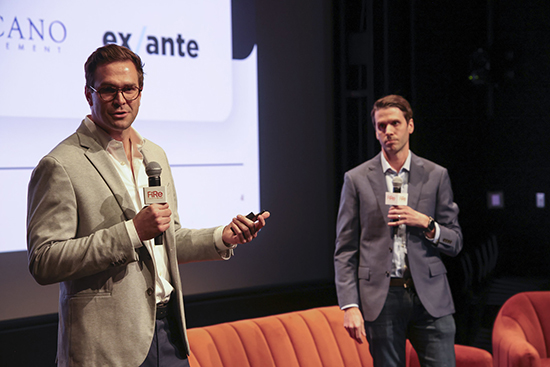
Watch the video of Pendulum's FiRe 2025 pitch. [1] https://www.newyorker.com/culture/infinite-scroll/watching-the-worlds-first-tiktok-war [2] https://www.demandsage.com/youtube-stats/ [3] https://www.wired.com/story/ukraine-russia-war-tiktok/ [4] https://www.pewresearch.org/internet/2025/11/20/americans-social-media-use-2025/ [5] id. [6] id. [7] https://www.pewresearch.org/internet/2023/12/11/teens-social-media-and-technology-2023/ [8] https://www.pewresearch.org/journalism/fact-sheet/social-media-and-news-fact-sheet/ [9] id. [10] id. [11] https://bpigroup.com/the-410m-cost-of-misinformation-for-coca-cola-rethinking-reputation-in-a-post-truth-world/ [12] https://www.foxbusiness.com/fox-news-food-drink/mcdonalds-ceo-misinformation-israel-hamas-war-hurting-companys-middle-east-business [13] https://www.dni.gov/files/ODNI/documents/assessments/ATA-2024-Unclassified-Report.pdf [14] https://www.contagious.com/en/article/news-and-views/cannes-lions-2025-social-and-creator-winners [15] https://youtu.be/ApwxlBruV90?si=YrlzGG1-Am5Dq9HL [16] https://www.businessinsider.com/gap-ceo-done-bombarding-consumers-with-promotions-2025-6 [17] https://www.retaildive.com/news/gap-old-navy-ceo-richard-dickson-brand-cultural-relevance/743535/ [18] https://siepr.stanford.edu/publications/working-paper/prediction-markets [19] https://kalshi.com/about [20] Ibid. [21] https://www.businessinsider.com/kalshi-cnbc-deal-cnn-data-integration-partnership-2025-12 [22] Ibid. [23] https://www.thestreet.com/investing/stocks/a-timeline-of-the-gamestop-short-squeeze [24] https://www.nasdaq.com/articles/meme-frenzy-pushes-these-etfs-higher%3A-will-this-continue [25] https://www.vaneck.com/us/en/investments/social-sentiment-etf-buzz/overview/ [26] https://stockanalysis.com/etf/meme/ [27] https://www.nasdaq.com/articles/meme-frenzy-pushes-these-etfs-higher%3A-will-this-continue [28] https://www.fec.gov/updates/statistical-summary-of-24-month-campaign-activity-of-the-2023-2024-election-cycle/ [29] https://www.opensecrets.org/pres12/expenditures [30] https://www.youtube.com/watch?v=hBMoPUAeLnY [31] https://rumble.com/v5k6p76-joe-rogan-experience-2219-donald-trump-interview.html [32] https://www.bitchute.com/video/4gGqMvuKJvpu [33] https://www.pbs.org/newshour/world/indias-latest-election-embraced-ai-technology-here-are-some-ways-it-was-used-constructively [34] https://www.dni.gov/files/ODNI/documents/assessments/ATA-2025-Unclassified-Report.pdf [35] https://www.rand.org/pubs/research_reports/RRA704-1.html
Copyright 2025 Strategic News Service and Mark Listes for Pendulum Intelligence. Redistribution prohibited without written permission. DISCLAIMER: NOT INVESTMENT ADVICE Information and material presented in the SNS Global Report should not be construed as legal, tax, investment, financial, or other advice. Nothing contained in this publication constitutes a solicitation, recommendation, endorsement, or offer by Strategic News Service or any third-party service provider to buy or sell any securities or other financial instruments. This publication is not intended to be a solicitation, offering, or recommendation of any security, commodity, derivative, investment management service, or advisory service and is not commodity trading advice. Strategic News Service does not represent that the securities, products, or services discussed in this publication are suitable or appropriate for any or all investors. We encourage you to forward your favorite issues of SNS to a friend(s) or colleague(s) 1 time per recipient, provided that you cc info@strategicnewsservice.com and that sharing does not result in the publication of the SNS Global Report or its contents in any form except as provided in the SNS Terms of Service (linked below). To arrange for a speech or consultation by Mark Anderson on subjects in technology and economics, or to schedule a strategic review of your company, email mark@stratnews.com. For inquiries about Partnership or Sponsorship Opportunities and/or SNS Events, please contact Berit Anderson, SNS COO, at berit@stratnews.com.
Thursday, November 27, 2025 SNS SPECIAL ALERT: PIVOT INTO CHAOS II By Mark Anderson This Special Alert is shareable with non-SNS members.
Sunday, November 23, 2025 THE TRILLION-DOLLAR PROMISE: ON DATA CENTERS AND DECEPTION By Evan Anderson The AI race has led to the construction of more data centers than even many of us in the tech sector ever imagined possible. At the same time, the promises being made by companies intending to build out AI tools are proving to be beyond dubious. Read on to find out just who is building all this capacity, how it's going, and where it will go from here
Sunday, November 16, 2025 POWERING AI RESPONSIBLY: THE CASE FOR COAL-ASSISTED CCS By John Pope | Special Letter | FiReStarter edition This week's issue, by Carbon GeoCapture CEO John Pope, will take you on a journey through the world of carbon capture. The company, selected for its innovative approach to repurposing old coal mines for carbon capture, twinning with datacenters to reduce climate impact, and the intellect of its leadership, is a standout among those seeking to sequester the world's carbon.
Sunday, November 9, 2025 IS THE FUTURE OF SOLAR IN SPACE? By Berit Anderson Globally, solar deployment continues to accelerate, as China drives cheap solar adoption worldwide. But even built on the backs of Chinese solar-company profits and forced labor, more acceleration is required. The next frontier may be in space. Friday, October 31, 2025 SNS SPECIAL ALERT: PIVOT INTO CHAOS By Mark Anderson This Special Alert is shareable with non-SNS members.
* Mark will be speaking at, and/or attending, the following conferences and events: * December 8-9: Fortune Brainstorm AI 2025, San Francisco * January 12-15, 2026: J.P. Morgan Healthcare Conference, San Francisco * May 31-June 3, 2026: Future in Review, Qualcomm Institute, UC San Diego
Strategic News Service (SNS) is a membership-based news organization providing the most accurate source of information about the future of technology as it drives the global economy. It is the publisher of the weekly SNS Global Report, which brings members predictive, deep-dive analysis at the intersection of tech, economics, and geopolitics. SNS hosts monthly virtual Spark salons, offering members access to its global network of leaders in business and industry and allowing them to capitalize on the insight and experience of the broader network. Annually, SNS releases CEO Mark Anderson's Top 10 Predictions for the coming year, which have a 95.3% publicly graded accuracy rating. Founded in 1995, the Global Report is read by industry leaders worldwide. Bill Gates has called it "the best thing I read."
Copyright 2025 Strategic News Service LLC "Strategic News Service," "SNS," "Future in Review," "FiRe," "INVNT/IP," and "SNS Project Inkwell" are all registered service marks of Strategic News Service LLC. ISSN 1093-8494 | |