 |
"Next Year's News This Week" Special Letter OFFLINE, NOT LEFT BEHIND: EDTECH AND AI FOR A (DIS)CONNECTED WORLD By Jamie Alexandre Co-Founder and Co-Executive Director, FiReStarter 2025 company Learning Equality ________ Introduction: Each year, Future in Review selects up to 12 companies using new technology to improve the world to be our honored FiReStarter companies. FiReStarters are invited to write a guest letter about the industry in which they operate, the promise it holds, and the ways in which our future might be improved by taking action in that space. In this week's issue, Learning Equality CEO Jamie Alexandre describes the state of global digital education today and how it may be improved. From matters of global access and the advent of AI tools to the use of offline software and more, Jami delves into how we can increase education access among the world's children, wherever they live. - Evan Anderson ________
The year was 2012. Education technology was booming, and the "online learning revolution" was the talk of the town. With the launch of Coursera and edX, and their rapid uptake by universities eager to ride the wave, the New York Times proclaimed 2012 the "Year of the MOOC" (massive open online course). Meanwhile, in the K-12 space, Khan Academy was a rising star. Funded by the Gates Foundation, the academy inspired visions of flipped classrooms, mastery-based learning, and a "free, world-class education for anyone, anywhere." As a young Cog Sci grad student caught up in this fervor, I was excited about the potential for education technology - and free and open-source models in particular - to level the playing field and enable universal access to education. While interning at Khan Academy that summer, however, I realized that despite our best intentions, we might actually be making things worse and further widening the divide. In reality, a full 65% of the world was not yet online; and those with the least connectivity were most in need of new opportunities. Paradoxically, by building education technologies that relied on the internet for distribution and access, we were further advantaging those who already had the most. Since then, by shifting approach and proactively building with and for the most disconnected communities around the world, we've been able to prioritize offline-first education technologies that leapfrog the divide and keep equity at the center.
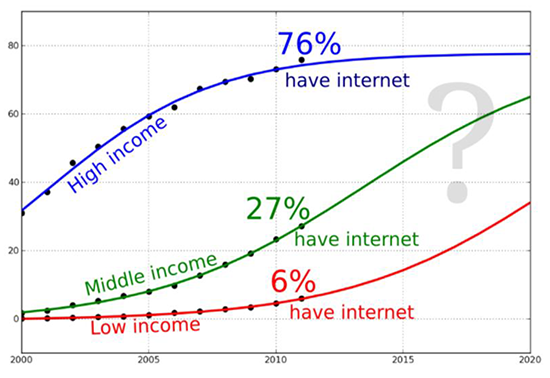
But surely the state of global connectivity has fundamentally changed in the past decade - hasn't it? So many of us now experience the internet as truly ubiquitous, to the extent that it's become popular to do a digital detox just to escape it once in a while. Back in 2014, when still only 40% of the world had internet access, I wrote: I have heard people estimate that the Internet should be fully ubiquitous within 10 years, but neither the history (e.g. the slow penetration of television into poorer areas around the world, with rates in the developing world only now reaching the levels seen in the United States in 1956), nor the quantitative data about internet growth rates, should be leading us to such a rosy estimate of the timeline for universal Internet. In particular, given the critical impact of access disparities on equitable educational outcomes, I split out national connectivity statistics by the World Bank's income tiers, demonstrating a perhaps unsurprising but still startling divide between wealthier and poorer countries. Fitting a sigmoidal growth model to this data, I projected that by 2020, 63% of the population in middle-income countries and 34% of the population in low-income countries would have gained access to the internet.
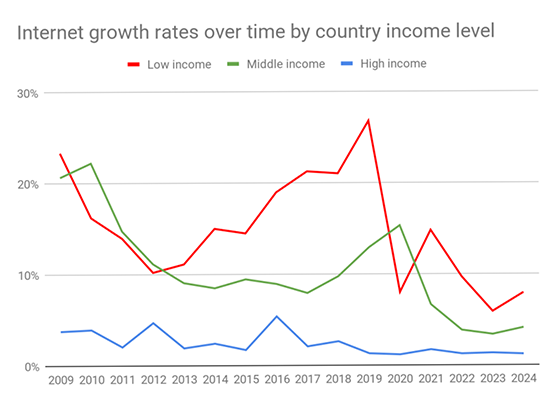
Source: Alexandre, 2014 While I had intended to emphasize a sober view of how long it might take to reach some level of connectivity parity, reality fell short of these projections. Current data shows that by 2020, low-income countries had reached 19% internet penetration and middle-income countries only 56%. High-income countries, on the other hand, had overshot the projection by reaching 89% penetration, further widening the access divide. And despite the spotlight the COVID pandemic cast on the importance of connectivity - and the significant infrastructure investments made as a result - the rate of connectivity growth plummeted significantly in the years that followed, as shown in the chart below:
Source: Alexandre, 2025 There is reason to be optimistic that innovative new infrastructure will help bridge the remaining gaps over time, but the existing solutions are not panaceas. People often ask about satellite internet - but despite increasing the global surface area that connectivity can reach, it remains an unaffordable option for a large portion of the world's population. Even for those who have achieved some level of connectivity, bandwidth often remains scarce, intermittent, and/or expensive, limiting its use in classrooms or homes. The Learning Crisis Deepens In parallel to this connectivity divide, we're witnessing a profound global learning crisis - particularly in the Global South, where disparities in access to quality education are stark. Right now, 272 million children and youth worldwide are out of school, and 222 million children are crisis-affected, needing urgent educational support. Even more concerning is that, according to a 2022 report by the World Bank Group, 70% of 10-year-olds in low- and middle-income countries are "now in learning poverty, unable to read and understand a simple text." And with an estimated one-half of the 2.6 billion people worldwide without internet access being school-aged, it's obvious how gaps in educational opportunity grow even wider. Teachers and learners in these environments face some clear realities:
Access to technology for teaching and learning can help address these challenges, but the digital divide compounds these issues, as many schools in low-income countries have minimal or no internet access, limiting learners' exposure to digital learning tools and resources that could enhance educational outcomes. These challenges exist primarily due to underfunded education systems, inadequate infrastructure, and insufficient teacher training, coupled with broader socioeconomic factors such as poverty and social instability. The lack of internet connectivity and technological tools in schools further widens the educational divide between developed and developing regions, leaving millions of children at a disadvantage.
Leapfrogging with Offline Edtech Addressing this crisis requires innovative solutions that transcend traditional educational methods and infrastructure limitations. Incorporating scalable, offline-first digital solutions, like the free platform Kolibri built by Learning Equality (of which I am CEO), can transform learning in under-resourced areas by providing high-quality, contextually relevant educational tools and content, accessible without the need for connectivity. This approach can help ensure that vulnerable populations are not left behind in the global shift toward digital education. _____ At Aywee Primary School in Northern Uganda's Palabek Refugee Settlement, under the midday sun in July 2025, 10-year-old Mary sets down her pencil and picks up a tablet. On its screen, she watches a short video explaining division, then glances at her teammates to build a real-world mini-market from cardboard and local materials. Two hours later, she confidently leads a show-and-tell of her group's project on budgeting. Just months ago, Mary struggled with basic math - and with school itself. Now, she's smiling, collaborating, and speaking out. In classrooms like Mary's, children face deep educational barriers: interrupted learning due to COVID, pervasive trauma, scarce resources, and little support for social-emotional recovery. Uganda grapples with serious educational backsliding; while over 90% of children enroll in primary school, enrollment drops at around Primary 4-Primary 5, with roughly one-half leaving by age 11. (See Learning Equality and hafuganda.org.) The pandemic exacerbated things; estimates suggest that about 30% of students didn't return when schools reopened in 2022 following almost two years of school closure. That's the gap our company's Flying Colors program was built to fill, enabling Mary's experience described above: an offline-first, tech-enabled version of project-based learning that treats foundational skills and social-emotional recovery as inseparable. In solar-powered learning spaces across Palabek, tablets running Kolibri deliver a locally aligned curriculum, while materials to support playful learning (cardboard, games, yoga mats, books, pencils) turn concepts into things learners can touch, test, and remake. Each week begins with simple breathwork and feelings routines adapted from Amal Alliance's Colors of Kindness program, helping children settle their bodies before they tackle literacy and numeracy activities at their own pace. Teachers, many using classroom technology for the first time, track progress in real time through Kolibri's coach tools, step in when learners get stuck, and guide small groups through a weekly project, prototyping solutions to everyday community challenges. Across two 12-week cohorts (714 learners), we saw not just improved skills, but also a visible shift in confidence and agency: almost every learner who completed the first cohort returned to mainstream school.
How Is AI Impacting Equity in Education? A new wave of innovations based on AI offers potential solutions but also introduces new disparities for communities without internet access. AI is already beginning to transform education, through tools for personalized learning, automated assessments, and data insights for better pedagogical strategies. Interactive learning aids like virtual tutors and chatbots can provide crucial support alongside, or even in the absence of, trained educators. However, existing achievement gaps further widen as these advancements fail to reach the disconnected, who are left without the benefits of these innovations and whose language, culture, and context become further underrepresented in the datasets being used to train the AI models underlying these tools. This will result in decreased digital access and skills for the digital economy, lower earning potential, and increased risk of poverty for these learners. While evidence is still mixed and risks remain high, for simplistic approaches like putting an AI chatbot in front of students as a personalized tutor, below are some key ways that new innovations in AI can directly support equity in education:
As we start to interact with problematic AI systems across all facets of our lives, being prepared to mitigate the risks and protect our own interests will be essential. For these reasons, gaining hands-on experience with AI, alongside scaffolded guidance and training, is becoming a critical goal for education. If we leave out of this equation those who are already most economically marginalized, we're just leaving them farther behind. Building offline-friendly AI and training materials into our education platforms will support building AI literacies and skillsets to better equip everyone for this rapidly emerging future.
Having been pursuing this vision since 2012, building an incredible global team and reaching over 13 million learners, I have learned, and learned again, the power of open models driven by community-driven adoption and the importance of designing systems that are catalytic rather than scaling linearly with effort. And I've seen how investment cycles with short attention spans, flitting between shiny new toys, can distract from resourcing systems change, equity, and long-term, sustainable infrastructure. With 2.6 billion people still offline and 272 million children and youth out of school, the problems we face as a global community remain immense. But my hope is that every time Sisyphus rolls the rock back up the hill, it gets a little bit lighter, he gets a little bit stronger, and the friends he's made along the way help keep things rolling. My organization, Learning Equality, is a nonprofit that plays a critical role in the education ecosystem. We directly enable organizations to make teaching and learning with technology possible, even when the internet is not available. We do this by developing public goods for the education ecosystem - tools that are open, sustainable, and based on real needs. Our work is funded by a mix of sources: philanthropic foundations, individual donors, and mission-aligned companies. Nonprofit tech infrastructure rarely gets the same attention as for-profit innovation, but mission-driven nonprofits make the ecosystem resilient, with their maintained tools, secure systems, open standards, shared data, and the behind-the-scenes work that keeps last-mile learning running. Because the market lacks financial incentives for serving the most marginalized and disconnected learners, we fill a critical gap in the ecosystem, which requires ongoing philanthropic investment. Learners in disconnected learning environments need quality tools to enrich and accelerate their progress, even in times of uncertainty. Our organization makes that possible. If you're looking for a high-leverage way to help close the learning and connectivity gap to counter the forces widening it, here are two concrete paths: Invest in offline-first learning for those who need it most. Offline-first education doesn't sustain itself and scale on hope alone. Programs such as Flying Colors and platforms like Kolibri work because they're built with equity at the center and are co-designed with the communities they serve, so they directly meet needs across diverse learning contexts. Individuals and foundations can champion this work by:
Join the cause.
Jamie Alexandre is the CEO and co-founder of Learning Equality. Before Learning Equality, he co-founded several educational technology platforms, including thisCourse, ESL Genie, and KA Lite. During his doctoral work, he conducted foundational research on language learning and grammar acquisition, then redirected his efforts toward developing equitable education technology. His dissertation work was recognized with UC San Diego's Chancellor's Dissertation Medal. A leader in offline-first edtech, Jamie has advanced solutions that expand access for learners in low-connectivity and disconnected settings. His work has been featured by the BBC, Harvard Business Review, Fast Company, Forbes, Bloomberg, NBC San Diego, and the San Diego Tribune. He is a TEDxUCSD speaker; has contributed to panels hosted by UNESCO, USAID, GBC-Ed, and Vodafone; and serves on Kiron's advisory board supporting post-secondary opportunities for refugees. Jamie holds a PhD in cognitive science from UC San Diego.
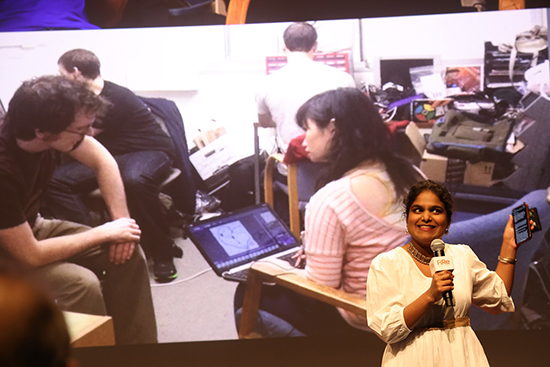
Navya Akkinepally, Co-Executive Director of Learning Equality, presenting on the mainstage at FiRe 2025.
You can see all Future in Review photos in these galleries.
Your comments are always welcome.
Copyright 2025 Strategic News Service and Jamie Alexandre for Learning Equality. Redistribution prohibited without written permission. DISCLAIMER: NOT INVESTMENT ADVICE Information and material presented in the SNS Global Report should not be construed as legal, tax, investment, financial, or other advice. Nothing contained in this publication constitutes a solicitation, recommendation, endorsement, or offer by Strategic News Service or any third-party service provider to buy or sell any securities or other financial instruments. This publication is not intended to be a solicitation, offering, or recommendation of any security, commodity, derivative, investment management service, or advisory service and is not commodity trading advice. Strategic News Service does not represent that the securities, products, or services discussed in this publication are suitable or appropriate for any or all investors. We encourage you to forward your favorite issues of SNS to a friend(s) or colleague(s) 1 time per recipient, provided that you cc info@strategicnewsservice.com and that sharing does not result in the publication of the SNS Global Report or its contents in any form except as provided in the SNS Terms of Service (linked below). To arrange for a speech or consultation by Mark Anderson on subjects in technology and economics, or to schedule a strategic review of your company, email mark@stratnews.com. For inquiries about Partnership or Sponsorship Opportunities and/or SNS Events, please contact Berit Anderson, SNS COO, at berit@stratnews.com.
Sunday, December 14, 2025 HOW LEARNING MODELS WILL SHAPE AI'S FUTURE By Berit Anderson With generative models seeing diminishing returns on massive compute scaling, AI's brightest minds are striking out on their own and going back to the drawing board. This week's Global Report explores the next generation of approaches, models, and strategies from Yann LeCun, Ilya Sutskever, and Mira Murati.
Sunday, December 7, 2025 SPECIAL LETTER: RISK AND OPPORTUNITY IN A TIME OF HYPER-DECENTRALIZED NEWS By Mark Listes | Special Letter | FiReStarter edition This week's issue, by Pendulum CEO Mark Listes, describes the shifting sands of the information environment, the rise of information warfare tactics being deployed across media by a coterie of actors both military and civilian, and what can be done to track and respond to these emerging paradigms in the digital information space. This FiReStarter Special Letter is shareable with non-SNS members.
Thursday, November 27, 2025 SNS SPECIAL ALERT: PIVOT INTO CHAOS II Friday, October 31, 2025 SNS SPECIAL ALERT: PIVOT INTO CHAOS I By Mark Anderson This 2-part Special Alert is shareable with non-SNS members.
Sunday, November 23, 2025 THE TRILLION-DOLLAR PROMISE: ON DATA CENTERS AND DECEPTION By Evan Anderson The AI race has led to the construction of more data centers than even many of us in the tech sector ever imagined possible. At the same time, the promises being made by companies intending to build out AI tools are proving to be beyond dubious. Read on to find out just who is building all this capacity, how it's going, and where it will go from here
Note: Some letters may be republished to include subsequent replies. Subject: SNS: HOW LEARNING MODELS WILL SHAPE AI'S FUTURE Berit, this is a very good report, I enjoyed it. It got me thinking about many of my cross-cut conversations (spanning friends in big tech AI labs and researchers in academic organizations / labs). I wonder if we are currently heavily and overly emphasizing words like 'general', 'super', 'frontier' and 'human superior', etc. intelligence. The big tech companies (not the AI researchers, but big tech CEOs, CFOs, EVPs, etc.) are under tremendous pressure to monetize the incredible expenditures being deployed to build these massive networks of AI-optimized datacenters. The tension (and lag) with that monetization is that the near-term customers that will pay for this - big enterprises - aren't looking for 'AGI', they are looking for ways to specifically and practically use AI to drive efficiencies, to become more competitive, and to increase speed and productivity. These things are not 'general', they are targeted to specific workloads and business areas. So as researchers chase AGI and superintelligence, the largest customers are looking for much more practical applications of AI to help their businesses and soon. As one CEO of a F100 business told me this weekend, "I don't need a superhuman who can do all the jobs in my company, I don't have that problem and I don't believe that's realistic. What I need is to see my AI investments drive material bottom line impact in my top three product areas - and each are entirely different in what they need." The CFOs of MSFT, AMZN, META, GOOG, etc. are not asking their AI teams for AGI, they are demanding real monetization of the massive investments they have already made in concrete and compute. That will come from focusing on large enterprises, and as someone who has worked with large enterprises and tech for many years, nothing is 'general'. This is not just fine-tuning super models, this will mean - I believe - many years of a concentrated focus from big tech on 'practical AI', overshadowing our over-focus on 'general AI' with AGI / Superintelligence being a much longer term goal, and interesting primarily to the scientific community in the next few years. I often chuckle when I hear companies talk about 'frontier firms' - enterprise companies I talk to want to see results from their AI investments, not a badge that they are drinking the AI kool-aid. And never underestimate the role of the CFO in big tech. :) Watch AWS in this space, they seem to be taking a much more pragmatic approach to applied AI in the customer environment, vs chasing a (very expensive) race to a scientific dream. Just my 2c :) Keep up the great work.
Bill Hilf Board Director, Advisor, Consultant
Bill, Completely agree with your assessments on the business side of things. I'm afraid the practical applications CEOs are looking for won't be meaningful or dependable enough under current architectures. Which means it may be a few years until they see the kind of widespread, practical utility to validate their investments. And that utility would need to be specialized to key business units or areas - customer service, analytics, etc. As for your AMZN comments, I do see them (smartly) not betting the farm, unlike some other major cloud providers, on building out their own generative models. Unlike Google, they're selling Levis, not panning for gold. I also see them making the same mistake as others (Alphabet, MSFT, etc.): burning out their top AI engineers by trying to replace them with LLMs that introduce further error and vulnerability into their code base. And in some cases forcing customers to use LLMs in ways that decrease the actual utility of their products. Curious to hear more of your thoughts on the ways they're improving practicality.
Berit Anderson
Berit, I just finished your latest SNS (HOW LEARNING MODELS WILL SHAPE AI'S FUTURE). Just in case you haven't heard about Pathways: Subject: Pathways, beyond Transformers https://www.wsj.com/articles/an-ai-startup-looks-toward-the-post-transformer-era-4e362db8 I hope you are doing well! Best,
Mark Mahan President, MMCO
Mark, Thank you. I had not. Pathways sounds like an important component of this future landscape. Excited to see what models they roll out in the new year. I expect we'll see more and more alternatives start to gain traction as investors grow less myopic on LLMs. (She said hopefully.) Do you know them personally? I'd love to connect with their team about speaking at FiRe.
Berit Anderson
Berit, Great issue. Very well written. Happy Holidays! Best,
John K. Thompson Analytics Leader & Innovator
John, Thank you. I appreciate the note as I know this is something you're tracking carefully. Happy holidays to you and your family. I hope you all have a wonderful year's end.
Berit Anderson
Subject: SNS SPECIAL ALERT: Pivoting into Chaos II Mark, This is an interesting perspective but it seems to assume that the "West" has a uniform view which would be the one of the US. But from Europe, USA imperialism, increasingly look worrying for many people. Furthermore, does it make sense to talk of a "free world" when most of what Europe does is directly or indirectly controlled by the USA? And to your point about AI, shouldn't non US-citizens worry too about what the USA is "doing right now, today, with these very real and dangerous tools"? (see e.g. https://www.authoritarian-stack.info/)
Philippe Delvaux
Subject: Re: Sir Richard Dearlove joins FiRe 2026 | Chief, MI6 (fmr.) Hello Berit, Dearlove is a great catch, well done. His work questioning the narrative on China's role around Covid is spot-on.. Kind regards,
Marcus Gibson Author, The Greatest Force
FiRe Team, Excited to hear what Sir Richard has to say at FiRe!
Jolene Anderson Co-Founder & Managing Director
* Mark will be speaking at, and/or attending, the following conferences and events: * January 12-15, 2026: J.P. Morgan Healthcare Conference, San Francisco * May 31-June 3, 2026: Future in Review, Qualcomm Institute, UC San Diego
Strategic News Service (SNS) is a membership-based news organization providing the most accurate source of information about the future of technology as it drives the global economy. It is the publisher of the weekly SNS Global Report, which brings members predictive, deep-dive analysis at the intersection of tech, economics, and geopolitics. SNS hosts monthly virtual Spark salons, offering members access to its global network of leaders in business and industry and allowing them to capitalize on the insight and experience of the broader network. Annually, SNS releases CEO Mark Anderson's Top 10 Predictions for the coming year, which have a 95.3% publicly graded accuracy rating. Founded in 1995, the Global Report is read by industry leaders worldwide. Bill Gates has called it "the best thing I read."
Copyright 2025 Strategic News Service LLC "Strategic News Service," "SNS," "Future in Review," "FiRe," "INVNT/IP," and "SNS Project Inkwell" are all registered service marks of Strategic News Service LLC. ISSN 1093-8494 |