 |
"Next Year's News This Week"
PARADISE LOST: HOW TECH HAS GONE ASTRAY AND HOW TO FIX IT By Evan Anderson _________ Why Read: Over the last 20 years, big tech has gone from society's darling to a field viewed with deep suspicion, even by those working in it. This week, we cover what went wrong and why, and how investors can re-incentivize the industry toward human values, societal progress, and a world worth living in. - era _________ Cars will soon have the Internet on the dashboard. I worry that this will distract me from my texting. - Andy Borowitz If we continue to develop our technology without wisdom or prudence, our servant may prove to be our executioner. - Omar Bradley Never before in history has innovation offered promise of so much to so many in so short a time. - Bill Gates
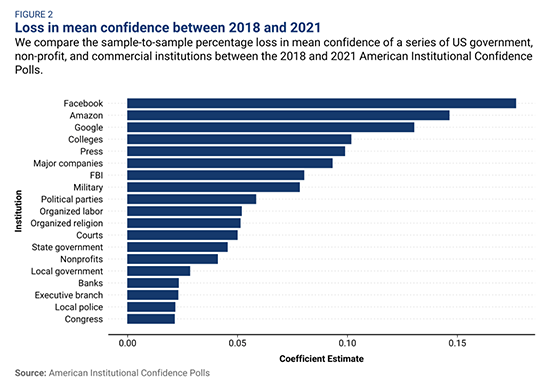
What a difference a day makes. If we look back to the early 2000s, the world of tech we saw then stands in stark relief to the one we experience daily now. In the days of what might now be termed "early modern" high tech, promises were so deeply rosy it was hard not to get excited. Move fast and break things was the mantra at Facebook. Well, things got broken, alright, and not only at FB. Even the employees of many of the other hallmark companies of today's "big tech" are no longer so excited about what they're working on (although lately they've been being laid off at a pretty rapid pace; problem solved). The suggestions are no longer that "tech can save the world," but rather are much more dystopian. Job loss is not being replaced with a universal basic income (UBI). Somewhere along the way, the societal benefits of technological progress got dropped. Meanwhile, the solutions being shopped out rarely seem to be for problems that "average citizens" ever voiced a desire to have solved. It all sounds increasingly like an infomercial in a sci-fi flick: "Hate your job? We'll remove it!" "Are you tired of making art? Let the computer do it for you!" "Too much money? Try gambling on everything all the time!" Small wonder, then, that among institutions, public confidence in big tech has declined faster than in any other category. In its 2018-21 run of polling, the American Institutional Confidence Poll found that big tech had suffered more confidence loss than any other institution:
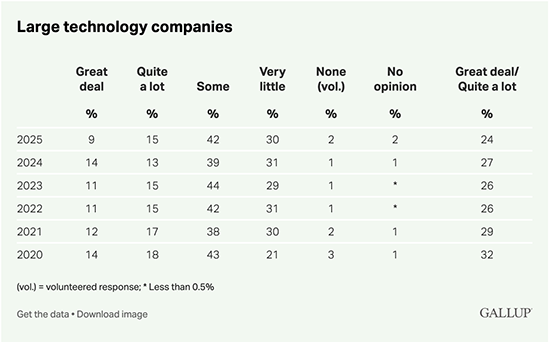
More recently, Gallup polling on institutional confidence found that between 2020 and 2025 combined confidence in large technology companies declined from 32% to 24%, with only 9% of those polled choosing "Great deal" as their confidence level. This left big tech only slightly better off than HMOs (19%), the US criminal justice system (17%), newspapers (17%), news on the internet (16%), big business (15%), television news (11%), and the US Congress (10%). Conversely, science, the US military, and small businesses all polled at or above 60% confidence.
What happened? Well, an awful lot. And much of it has been deeply damaging. In international aid work, there is a term for in-kind donations that wind up on the front line of developmental aid that is absolutely useless: SWEDOW, or "sh*t we don't want." Unfortunately, some tech leaders have developed a penchant for working hard to hype and deliver quite a bit of their version of SWEDOW lately, at great cost to themselves, investors, and human society. Let's take a look at some of the trends pushed by the Valley in the last decade and see how they've turned out for us. |