 |
"Next Year's News This Week"
The depreciated dollar: Currency Wars, Eye-for-an-Eye Economics, and the Rough Road Ahead By Evan Anderson ________ Why Read: Devaluing the US dollar serves multiple purposes: combating foreign currency manipulation and dumping and inflating away national debt. But the burgeoning currency war is also risky. This week, we cover historical contexts for the global economic situation, the state of currencies today, and why President Trump likely wants a cheap dollar. Read on to learn what it means for us as employees, businesspeople, investors, and owners of money. ________
... [I]t is peculiarly the duty of the national government to secure to the people a sound circulating medium ... furnish[ing] to the people a currency as safe as their own government. - Abraham Lincoln A currency war between nations is a tit-for-tat policy of official currency devaluation aimed at improving nations' foreign trade competitiveness at the expense of other nations. Currency devaluation is a deliberate move to reduce the purchasing power of a nation's own currency to boost its export sales. Countries may pursue such a strategy to gain a competitive edge in global trade and reduce their sovereign debt burden. Devaluation can have unintended consequences that are self-defeating; the worst of these is inflation. During a currency war, a nation's consumers also bear the burden of higher prices on imports. - Investopedia Money, it's a gas. - Pink Floyd, "Money," The Dark Side of the Moon
Throughout history, nations and empires have played an on-and-off game of chicken with their own currencies. At times, this looks like the era of quantitative easing seen after the Global Financial Collapse of 2007/2008, or the COVID-19 pandemic economic response around the world. Firehoses of cash that go pouring into the economy to avoid disaster do, of course, have consequences. Usually, the contours of those consequences are defined by the eras of high inflation seen immediately afterward. Bubbles appear, economies overheat, and the price of goods for the public becomes nothing short of painful - doubly so if wages don't shift markedly while the money supply does. There is more to international financial competition, however, than meets the eye.
U.S. exports to retaliating countries fell by as much as 33%, with U.S. trade partners specifically targeting high-end, branded consumer products, such as U.S. autos. The drop in trade contributed to the Great Depression, which in turn triggered a large currency war: between 1929 and 1936, 70 countries devalued their currencies relative to gold. We show that trade was further reduced by more than 21% following devaluation. The currency war destroyed the trade-enhancing benefits of the global monetary standard, ending regime coordination and increasing trade costs. The 1930s are a potent reminder of what can happen when international policy coordination breaks down and countries go it alone when negotiating trade and exchange-rate policies. - Kiel Institute for the World Economy, Policy Brief, "Trade Wars and Currency Wars: Lessons from History" (May 2025)
Among the forms of economic warfare available in the toolkit of nations is a proper devaluation of one's own currency for the purpose of outcompeting trade partners. This tactic, seen particularly in Japan in the 1980s and '90s and in China from around 2000 on, works well to siphon manufacturing and production from those targeted, as the cheap goods that result in domestic markets of countries with higher-value currencies outcompete those produced in-country. But this tactic in our most modern times only worked in such a one-directional fashion because the original currency in the targeted nations (read: the US, the EU) stayed roughly stable and much higher.
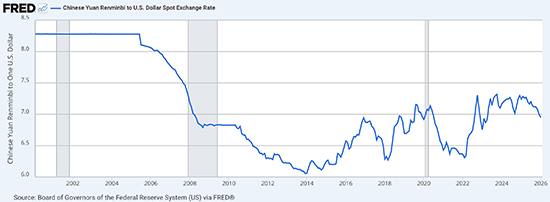
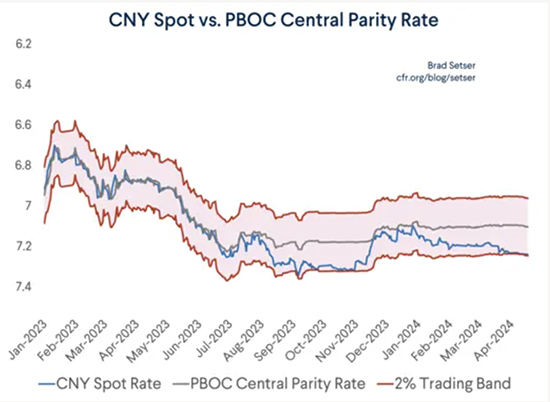
Source: Council on Foreign Relations The charts above show two eras illustrative of a currency manipulated by a central government. In the top chart, the open pegging of the Chinese yuan by the government of the People's Republic of China (PRC) circa 2000-06, and again during the 2008 financial crisis, are obvious due to the flat lines in the exchange rate. The second chart shows the new approach adopted by PRC officials after the country's accession to the WTO and much complaint from its trading partners worldwide. There was a shift to a daily peg that allowed for some movement but kept the currency within a band that belies the idea that it truly "floated." But things can get a lot weirder. |