
|
The most accurate predictive letter in computing and telecommunications,
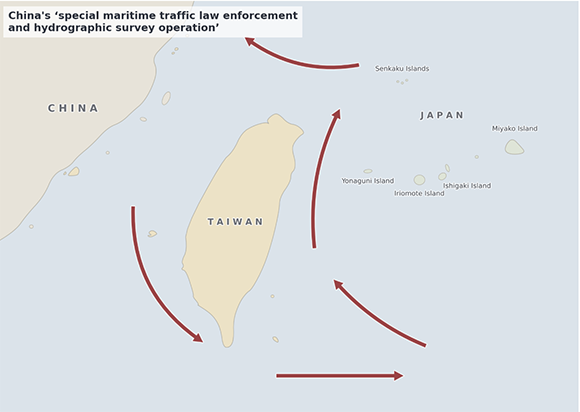
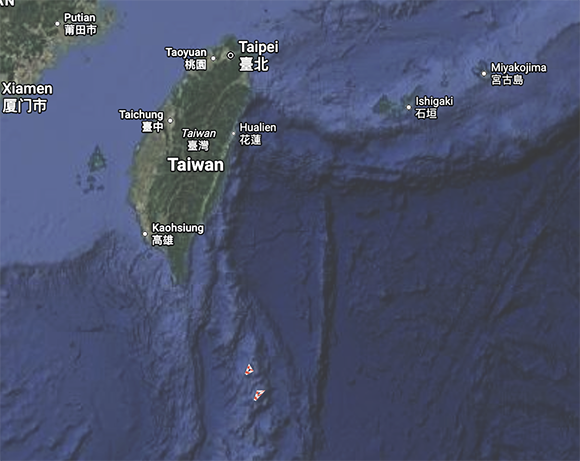
Blockade of Taiwan Imminent "Chinese President Xi Jinping has pledged to achieve the 'reunification' of China and Taiwan, calling Beijing's long-held goal 'unstoppable.' "In a New Year's address delivered a day after China's military wrapped up war games around Taiwan, Xi on Wednesday invoked the 'bond of blood and kinship' between Chinese people on each side of the Taiwan Strait." Al Jazeera, January 1, 2026 For years, whispers have flown from ear to ear in the halls of Washington, DC about when, exactly, Xi Jinping intended to act on his promise to seize Taiwan. 2027 has long been the quiet consensus in the intelligence community. That made strong sense and was based on careful collection of data over decades on how many war materials, of which types, could be assembled by that year that would enable the PLA to finally cross the Strait. But adversaries rarely follow the rulebook we plan for them. Since 1949, Beijing has dreamed of invading Taiwan. As Chairman Mao prepared the PLA and worked to build enough ships for an attempt, his massive spy ring on the island was caught. In the words of Ian Easton, "The invasion of Taiwan was put on hold until Beijing could figure out what to do." Xi Jinping has renewed that dream. His main and final goal has long been to take over the island. The question of when has just been answered: it begins now. Despite all the talk of a full-scale invasion, Russia's foray into kinetic imperialism has been a strong indicator of the pitfalls of starting major conflagrations. So, too, has the US's decapitation success in Venezuela and ongoing crisis in kinetic warfare in Iran been instructive. We should not expect the Chinese military and intelligence leadership to ignore obvious lessons in the asymmetric peril of modern drone warfare and the efficacy of softer means. They, too, know that Taiwan has been building a drone army and preparing for a kinetic war. The simplest solution is the one they have just begun to enact. Xi's firing of all the top PLA leadership this year is likely for a simple reason: if you aren't a yes-man, you're gone. This implies an intention to not only control the PLA (he already did), but also to do something with it that the military itself does not particularly want to do. The PLA is now likely on standby to do whatever it must, and it has been preparing for a bloody and potentially disastrous landing for 77 years. But an astute strategist (and Xi has shown to be nothing short of that) knows that kinetic military means are the means of last resort. Instead, a blockade is afoot. First, as a form of quiet escalation, China has been steadily increasing naval and air activity around the island for years. According to a July 4 article in Reuters: "As of Friday, Taiwan was tracking a record of more than 110 Chinese military and Coast Guard ships up and down the First Island Chain, Joseph Wu, secretary-general of Taiwan's National Security Council, posted on X late on Saturday." But things have now gone further than that. As of this week, the Chinese government has announced that it will be patrolling what it claims is its own territory east of Taiwan. According to the Australian Strategic Policy Institute: Previously, Chinese government vessels operating east of Taiwan were mainly warships engaged in military exercises. But in June, for the first time, China sent vessels of its Transport Ministry, which is responsible for securing sea lanes, to seas east of Taiwan in a "special maritime traffic law-enforcement operation." Source: Australian Strategic Policy Institute Furthermore, China is now claiming the northern Philippine province of Batanes, a set of small islands directly south of Taiwan, outlined in red below.
Source: Google Maps (screenshot) Both of these moves are highly escalatory, and both point to one simple fact: China intends to blockade Taiwan, starting effectively now. Add to that the testing of ballistic missiles and the beginning of joint Chinese-Russian naval exercises off the coast of Qingdao (near South Korea), all while the US Navy is rather occupied in the Persian Gulf, and the amount of escalation in a single week would be frivolous to ignore. The implications of such a move are massive. For one, the global (and US) economy remains extremely reliant on Taiwanese chipmaker TSMC's products. TSMC continues to hold a 72% market share of pure play chips and a virtual monopoly (90%) on more advanced (2nm) chips. China, falling behind in the chip race, is now positioned to cut off the world's supply in one move. Geopolitically, controlling Taiwan also allows China to control the world's most crucial shipping lanes, while more effectively providing a stepping stone to threaten both Japan and the Philippines. China is claiming territory currently controlled by both nations, and both are also preparing for war. For now, it's clear that the initial plan is simple: blockade the island and force it to its knees. The likelihood of political warfare and sabotage are also therefore at a peak high, with the mainland-friendly Kuomintang (KMT) the likely favorite of the PLA to administrate the island.
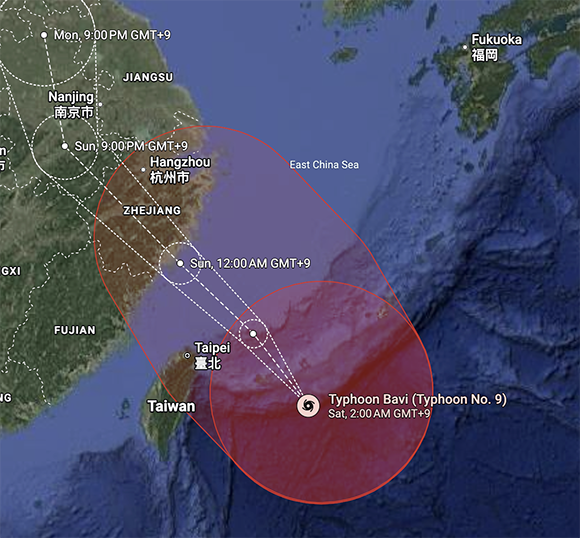
Source: Google Maps (screenshot) With the massive Bavi typhoon currently bearing down on Taiwan and mainland China, the confluence of escalatory events and the wrath of nature make this coming week the most dangerous time in the island nation's modern history. If weather and the whims of Xi Jinping play out badly, Taiwan could find itself battered and blockaded within days. For that reason, we have issued this Special Alert to keep you apprised of the situation. We encourage you to send us any of your thoughts or strategies for how a blockade could be foiled, short of a kinetic conflict that threatens to quickly develop into a global, or at least theater-wide, conflagration.
Your comments are always welcome, Mark Anderson Evan Anderson |
_____________
You received this message because you are subscribed to the Strategic News Service.
2026 Strategic News Service, PO Box 1969, Friday Harbor, WA 98250. All rights reserved.
