 |
"Next Year's News This Week" DIRE STRAITS II: ECONOMIC SITREP By Evan Anderson ________ Why Read: The ongoing US/Israeli-Iranian war over the Strait of Hormuz is now technically in its sixth month. While damage to economies reliant on the oil, gas, and fertilizer that transit the Strait has been mitigated in some ways, the bill is also soon to come due. Read on for more about the current situation in the Strait, what countries have done to address the shortages, and the risks and rewards that are emerging from the conflict. ________ Brent crude futures was [sic] up 57 cents to $96.20 per barrel. The international benchmark broke $97 earlier in the session. U.S. West Texas Intermediate traded 85 cents higher at $91.86 per barrel. Kuwait's armed forces said Thursday that the kingdom was facing "ongoing Iranian aggression" as the country's air defenses engaged missiles and drones, according to the Kuwait Times. - CNBC (9/3/26)
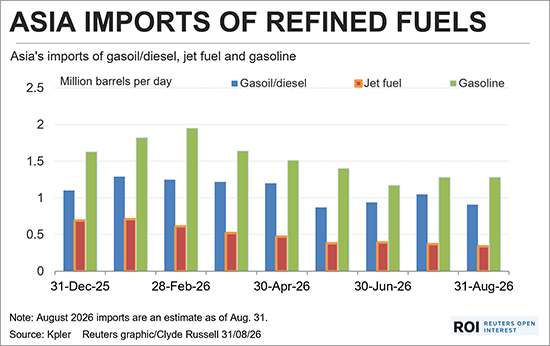
Since the start of the US/Israeli-Iranian war in late February, the stability of the global economy has teetered on the brink. Shocks to oil and gas supplies, particularly across East Asia, were swift. Nations have drawn down strategic reserves around the world, seeking to buffer their economies from a dramatic slowdown. Meanwhile, the fertilizer supplies that normally flow freely through the state are in a similar chokehold, forcing global supply chains to (unsuccessfully) work to pick up the slack in the midst of a war in Ukraine that has also shocked supply for years. In March, I penned Part I of the SNS Global Report on this topic: DIRE STRAITS: Hormuz Inflation, Asymmetric Warfare, and Manufactured Crisis, in which I stated: With no clearly stated exit plan, it seems that the US and Israel have jumped headlong into a conflict that may last months, at least. But the world, and Asia in particular, doesn't have many months to last. Since that time, two paradigms have emerged. First, the initial prediction has clearly come to pass. With more Iranian missiles raining down on US bases in the region and tankers struck during midnight attempts to run the gauntlet, the Strait is at the very least under serious contention today, a full five months after the initial American attacks on Iranian ground targets. US forces are also increasingly running low on ammo, particularly for the Patriot missile interceptors now in heavy use. Meanwhile, reductions in European stocks have broadened NATO and Ukrainian vulnerability to Russian missile strikes. According to PBS, citing an anonymous US official on August 27: In Europe, the American military "definitely" does not have enough Patriots to stop any possible sustained ballistic missile attack and would have "very limited" capability to defend against a single ballistic missile strike or a stray Russian missile that goes off course, the U.S. official said. It illustrates the cascading fallout from Trump's decision to launch a war against Iran, a conflict that reaches the six-month mark Friday. U.S. missile stocks in Europe have been moved to the Middle East, where U.S. and Gulf allies have fired off significant numbers of interceptors, including Patriots, to thwart Iran's drones and missiles. Some of those attacks have killed and wounded American troops. The US administration, apparently currently focused on renaming the Strait after Donald Trump, may soon lack the ability to defend against Iranian strikes - just as China ramps up military support for the regime. From missile fuel to one-way Shahed attack drones, the Chinese government is supplying the country's Islamic Revolutionary Guard Corps (IRGC) with more and more tools, solidifying the CRINK alliance of China, Russia, Iran and NK yet again in a broadened conflict with Israel and the West. Second, Asia has managed to fend off a full-blown fuel crisis, as dwindling strategic reserves have been relieved of the initial pressure by some adjustments in the amount of oil and gas making it through the Strait. Still, imports in Asia of refined fuels have dropped severely since the prewar days, with refined gasoline down to 1.25 million barrels per day (bpd) from 2 million bpd prewar. The most drastic drop in imports for the continent has been in jet fuel, which went from around 0.75 million bpd to closer to 0.25 million, a roughly 66% decline. That will be the first main pinch point for the continent should the conflict drag on. Countries across East Asia are rushing now to shore up reserve capabilities and diversify supply chains. But those efforts, while worthy, take time. The capacity being built out will not be online fast enough to address an ongoing crisis throughout the fall. The coming months will tell whether emergency measures are beginning to have an effect, but the risk of serious economic damage remains extremely high.
The entire global economy risks deceleration, stoppages, and even stagflation should the situation continue. The fertilizer shortage simultaneously threatens the global food supply. And food doesn't get transported and delivered without trucks, trains, and ships that require their own fuel to move. Thus, the status of the Strait, and how much is moving through it, is critical for much of the world's population and the global economy. How much oil, gas, and fertilizer gets through will be a key driver for global health and prosperity for the remainder of 2026 and, at this point, most of 2027.
|