 |
"Next Year's News This Week" THE FUTURE OF LIFE IS ELECTRIC Michael Levin's work on bioelectricity is poised to revolutionize development, human augmentation, intelligence, and aging By Berit Anderson ________ Why Read: Hundreds of years into the development of human biology as a discipline, we're still just beginning to discover how life works. This week's Global Report takes you inside the emerging role of bioelectricity in dictating the development of life, aging, and human development. - bba ________ I was sitting outside an Italian restaurant in downtown La Jolla last fall, talking with John Mattison, Future in Review advisor and former CMIO at Kaiser Permanente, when I first heard about Michael Levin. SNS members who know John know that he is an effusive font of ideas and inspiration. Each story he tells seems to remind him of another story - about science, philosophy, technology, and the nature of life. Levin is a similar type of character. So John's enthusiasm for his work stuck with me. It turns out I was late to the party. Levin's research group at Tufts - the Levin Lab - numbers more than 65 members and has spawned 62 peer-reviewed papers in just the last two years. His own body of research goes back much further. Since 1993, Levin has been working to advance scientific understanding of bioelectricity - the way human cells use electrical currents to communicate. His discoveries and creations in this space are both brilliant and a little terrifying - including a gaggle of biological robots, two-headed cnidaria, and frogs unexpectedly regenerating limbs where they don't belong.
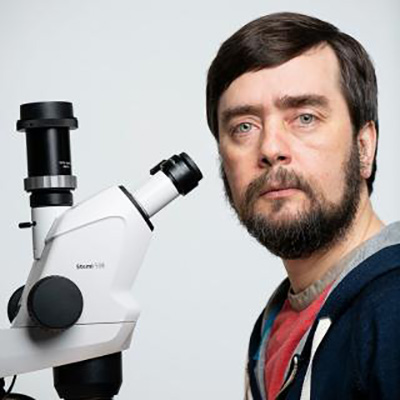
Photo: Tufts At the core of his research is the discovery that DNA and RNA are not the only arbiters of biological development. He calls them the "hardware." The "software," as he describes it, comprises bioelectric signals passed from cell to cell that provide a type of blueprint for biological development. Interestingly, these signals do not provide detailed descriptions to other cells of how to work through things. For example, they do not say: "First put Cell 1 by Cell 2, then merge with Cell 3." They simply say: "Make a tail" - and then somehow all work together to grow a new tail. It turns out the software (bioelectricity) can reprogram the hardware (DNA & RNA) to create entirely different outcomes. Levin and his team have been able to install electrical signals of their own in cells, changing the outcome of their development without changing their underlying DNA. The potential implications of these discoveries are among the most revolutionary in modern biology. Levin's research indicates that bioelectricity may allow us to repair birth defects, cure cancer, and extend human longevity - potentially by hundreds of years. He already has companies working on all three.
|