 |
"Next Year's News This Week" CLEAN TECH: Cracking the Chinese Chokehold on REEs & Precious Metals By Evan Anderson ________ Why Read: China maintains a stranglehold on rare earth elements and precious metals. It does not appear to have any interest in returning to an era of steady supply to the US. Last year in these pages, we covered what could be done to increase the global supply of these resources. This week, we cover ways in which new companies are reducing the need to use REEs, cobalt, and lithium in the products required for a modern economy, military, and solution to the climate crisis. - era ________ The Middle East has oil, China has rare earths. - Deng Xiaoping We shouldn't be transitioning to the use of electric vehicles at the cost of the people and environment of one of the most downtrodden and impoverished corners of the world. [...] The bottom of the supply chain, where almost all the world's cobalt is coming from, is a horror show. - Siddartha Kara, T.H. Chan School of Public Health, Harvard
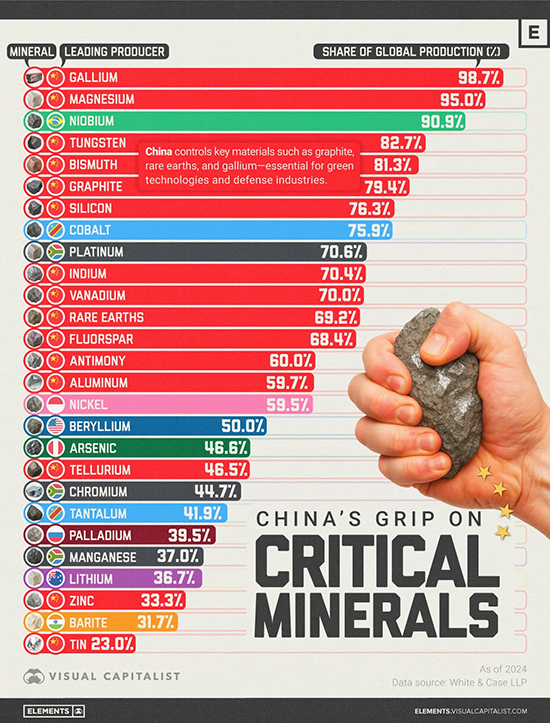
In September 2025, we published SNS: "Medium Rare: How to Break the Rare Earth Element Chokehold." There, we described the ways in which the Chinese monopoly on sources, particularly in refining, leads directly to adverse political and geostrategic outcomes for those seeking to challenge China's actions and policies. Given the leverage that a monopoly on rare earth elements (REEs) affords the Chinese state, this remains one of the tantamount issues of our time. Shortly after publishing that piece, I received the following from the president of one of our 2025 FiReStarter companies, in reference to a carbon graphite plate that was key to their business and wholly made in China: We've been running into a different wall of export controls, and I think these controls are much broader than just the rare earth elements but are flying under the radar a bit. We had a very large order in for carbon graphite plates and the US supplier kept being real cautious about when they'd ship to us. We know them very well (we've worked with them for five years), so eventually we were able to get through to someone we know who let us know that no plates were coming anytime soon. The paraphrased quote from our supplier was the following: With our supplier in China, we have been trying different ways to get your plates shipped out to us. None of those methods worked so far. The freight forwarding companies have been sending back the material back to the manufacturer after it arrived at the China Customs. The constantly changing restrictions from the Chinese government are making it very difficult to get this product out of China for the moment. So there you go. We have two other US suppliers for this component, and both of them have said much the same. One of them warned us of this (accidentally) about two months ago. Anyway, we're seeing it right now in September 2025, and had no problems sourcing these materials previously, so I think broader geopolitical flexing is happening beneath the surface. I'm sure that's well known and appreciated, but I thought you might enjoy knowing about one particular anecdotal example where it's hitting US clients (e.g., us, a small and not-currently-a-clear-geopolitical-target business). So, too, are key minerals such as cobalt, sourced from slave mines in the Democratic Republic of the Congo, in a chokehold. China refines 70% of the world's cobalt. But the list only grows from there. From gallium to magnesium, from tungsten to graphite and silicon, when it comes to the materials that make our modern world - and militaries - go, the global economy is effectively at the mercy of the whims of Xi Jinping and the Chinese Communist Party (CCP). In July 2026, in SNS: "Medium Rare II: Critical Minerals, Rare Earth's, and The Trade War," we highlighted the ways in which the People's Republic of China (PRC) was indeed using the leverage afforded by its REE and precious-metals market monopolies to strangle US policy. Given China's position as a key adversary to the United States, and to many countries across East Asia and Europe, its grip is untenable.
In both "Medium Rare" and "Medium Rare II," we discussed the many frantic efforts across the globe to replace that supply and open up space for maneuvering for the US and its allies. Increasing supply is the first place to look for that room, and it can be done: the US used to mine and refine many of these REEs and metals itself. And while not simple, recycling or reusing these elements is also a worthwhile endeavor. But let's face it: this is downright filthy work, however you look at it. Mining damages our environment in myriad ways - and many of these REEs and metals (like cobalt) include highly toxic chemicals and processes required for refining that leave whole regions polluted wherever they take place. This is why, several lifetimes ago (by technology standards), the world was initially happy to let these industries go. China saw an opportunity to gain global heft by taking that bullet, and took it. So while re-establishing supply outside of the chokehold is key in the immediate, it would be better by far to lessen demand overall. Can this be done? Of course. Doing so also provides a major business advantage: by changing how we make technology, and which technology we choose to put in our products, companies can drastically lower prices and make less-complicated tools. Making money, reducing dependence, and lowering prices for the customer represents a win-win-win situation that also strengthens national security. It would directly reduce slavery, money flowing to militant groups and the Chinese state, and pollution. Oh, and it's investable, too. Let's take a look at some companies working to strip the strip mining out of the tech stack, and what they are building.
|