 |
"Next Year's News This Week" the Long Betrayal: RUSSIA, Trump, Musk, and how we got here By Evan Anderson _________ Why Read: Much was made by the Trump administration of the so-called "witch hunt" in the 2016 election cycle when its purported ties to Russia were exposed. Times have changed. Now increasingly drawing bipartisan condemnation, the administration seems hell-bent on helping Russian interests, at all costs, in advance of the US midterm elections. This week, we examine why the ties between the Trump administration, those who aid and abet its criminal activity, and Russian intelligence, government, and money are a "clear and present danger" to US national security. Read on for a description of Russian tactics for gray-zone, information, and psychological warfare; the blatant cooperation between our administration, Putin, and the KGB/FSB; and what to expect next, as these forces move to finalize the permanent reduction of the American state. - era _________ A nation can survive its fools, and even the ambitious, but it cannot survive treason from within. - Cicero Putin is playing President Trump like a fiddle. - Senator Thom Tillis (R-NC), CNN (10/20/26) Treason against the United States, shall consist only in levying War against them, or in adhering to their Enemies, giving them Aid and Comfort. No Person shall be convicted of Treason unless on the testimony of two Witnesses to the same overt Act, or on Confession in open Court. - Article III, Section 3, Clause 1, The United States Constitution
On February 8, 1970, Soviet propaganda officer Yuri Bezmenov, posted to India the previous year, left his post in New Delhi to see an American film assigned to him and two colleagues. Feigning having forgotten to purchase a ticket, he remained outside the theater, ostensibly to buy one from a scalper. He then donned a disguise. Dressed as a hippie, he joined a tour group to Athens and began his defection to the West. Fourteen years later, he sat down for an interview in which he described the Soviet plan to take down the United States. Claiming that its plan for ideological subversion relied on destroying the US from the inside, he said it would proceed in four stages over roughly 40 years. Eighty percent of Russian operations, he said, were devoted to ideological subversion, active measures, and psychological warfare. Here is how he defined "ideological subversion": What it basically means is: to change the perception of reality of every American to such an extent that despite of the abundance of information no one is able to come to sensible conclusions in the interest of defending themselves, their families, their community, and their country. It's a great brainwashing process that goes very slow, and is divided into 4 basic stages. The stages he described were as follows: Stage 1: Demoralization: 15-20 Years A period of information and active-measures warfare to slowly shift the information ecosystem for a full three generations of students. The ultimate goal would be to make it impossible for Americans to understand their own reality, and therefore to stun them into submission. Bameno claimed the process was irreversible and was nearly complete in the mid-1980s, explaining: "A person who was demoralized is unable to assess true information, the facts tell nothing to him." Stage 2: Destabilization: 2-5 Years The targeting and destruction of key sections of the nation's strength. The military, economy, and foreign relations of the nation are identified as top targets. Stage 3: Crisis: "May Take Only Up to 6 Weeks" A period wherein the destabilization comes to a head and the nation is entirely dysfunctional. Stage 4: Normalization: Final, Indefinite A cynical expression from Soviet propaganda, "normalization" occurs when the powers that be declare that everything is fine in the "new normal." According to Bezmenov in his 1984 interview: This is what will happen in the United States if you allow these schmucks to bring the country to crisis. To promise people all kind of goodies and the paradise on earth, to destabilize your economy, to eliminate the principle of free market competition, and to put a big brother government in Washington D.C. with benevolent dictators like Walter Mondale who will promise lots of things, never mind whether the promises are fulfillable or not. He will go to Moscow to kiss the bottoms of a new generation of Soviet assassins, never mind. He will create false illusions that the situation is under control. The situation is NOT under control. Situation is disgustingly out of control. What was to be done to avert this process, Bezmenov continued, was simple: educate the American population about the dangers of Soviet ideology, and pull out all stops to halt the process of the Soviet military industrial complex from destroying what is left of the free world. It would not be hard, he said. All that was required was: [...] no credits, no technology, no money, no political or diplomatic recognition, and of course no such idiocy as grand deals to the USSR. The Soviet people, 270 million Soviets, will be eternally thankful to you if you stop aiding a bunch of murderers who sit now in the Kremlin and whom President Reagan respectfully calls "government." They do not govern anything. Sage advice. What proceeded over the next two decades was not, of course, the fall of the free world, but instead that of the USSR. As the wall fell in Berlin, a new era of peace was heralded by leaders in the US and Europe. And while Russia descended into chaos, it did, for a moment, appear that it would emerge under the leadership of Boris Yeltsin to open up and join a free Europe as a standard free-market economy with more democratic values. But the KGB had other plans.
First and foremost it is worth acknowledging that the demise of the Soviet Union was the greatest geopolitical catastrophe of the century. [...] As for the Russian people, it became a genuine tragedy. Tens of millions of our fellow citizens and countrymen found themselves beyond the fringes of Russian territory. - Vladimir Putin, State of the Nation Parliamentary Address (April 2005)
While the USSR's project to destroy the US from the inside out may have been disrupted, it could always be pursued anew. Ahead of the Soviet collapse, the KGB was already reading the writing on the wall. The real key was to remove the assets of the state quickly and abscond with them, so that KGB influence could be preserved and the Russian state rebuilt. The agency, in control of many of the businesses and much of the cash across Russia, got to work. First, a system for acquiring foreign technology had been established under Gorbachev. Centered around Dresden in then-East Germany (where a young Vladimir Putin was operating as a KGB agent in the late '80s), the system was a financial one. Banks were set up for state enterprises, and those banks opened joint ventures abroad. While the flow of money was supposed to bring technology in, it was a two-way valve. According to American Affairs Journal: This arrangement produced none of the innovation and entrepreneurial vigor that Gorbachev had envisioned. On the contrary, Russia's business leaders had plenty of incentives to make profits, but none to invest them. Executives could sell state assets to themselves or their partners at artificially low, state-fixed prices, and then sell them on to third parties at the market price. Zubok, like Kotkin, uses the word "cannibalization"5 to describe the process. Kotkin notes that exporters "accumulated fortunes that were hidden abroad by using mechanisms that the KGB had developed to pay for industrial espionage."6 That stands to reason, for in the early stages, who but the KGB knew how to set up a shell company in a tax haven? Who knew how to buy a mansion through a trust? Once the system was up and running, of course, Western investors graciously agreed to fill this advisory role. The system flipped. Now, old-guard KGB agents uninterested in a Russia that was soon to shift toward a free-market economy decided to get out. Where to park the money they needed to move was a different question. In an excellent exposé on the workings of this system, Catherine Belton MBE, a British journalist and the former Moscow correspondent for the Financial Times, described it in its near-entirety when she penned Putin's People (2021). The book details innumerable connections between the Trump empire and various Russian or Russian-affiliated agents, ranging from Georgian and Azeri real-estate tycoons to Brighton Beach mobsters and KGB oil traders. Notably, Belton documents the ties these individuals all had to KGB money flowing out of the USSR, the ease with which real-estate investment allowed them to avoid scrutiny (laws are far more permissive, and transactions can be easily done through shell companies), and the degree to which Donald Trump's Taj Mahal casino suddenly became a frequent, beloved stop for all of these characters. This last point makes sense. By the early 1990s, Trump was in deep debt, with a defunct Taj Mahal casino and an empire that was bleeding cash. He had already attracted Soviet and Czech intelligence and had traveled to Moscow in 1987 to investigate, in his own words, "building a large luxury hotel, across the street from the Kremlin, in partnership with the Soviet government." All of this at the invitation of Soviet ambassador Yuri Dubinin. So, the ground was laid for a longstanding relationship. A business empire in shambles was suddenly saved, at exactly the same time that a lot of Russian money tied to the KGB arrived in town, in flight from the imminent collapse of the USSR. While people like Azeri-Russian real-estate tycoon Aras Agalarov would go on to do business with the Trump family for years (and eventually offer aid in Trump's 2016 election campaign), the money had already begun to flow. Money laundering had also begun in full: FINCEN fines for the Taj Mahal would continue all the way to 2015. Let's examine Bezmenov's four stages in the context of what has taken place since Putin rose to power.
Deputy Attorney General Todd Blanche said Friday morning that while the DOJ intends to release "hundreds of thousands" of [the Epstein] documents by the deadline, it will release the rest of the files in the coming weeks as redactions are made - which is not allowed under the federal law. - Forbes (12/19/25)
As the chaos of the 1990s began to subside, Putin was making his way from an administrative role in St. Petersburg amid the mad dash to bring in Western companies to the halls of the Kremlin. The short, strange little man with the darting eyes was busy. By the time Yeltsin was finally leaving office in 1999, he had set all of the pieces on the board to ascend to power. Vladimir Putin's takeover of Russia was characterized by exactly the kind of crony capitalism that would emerge from the disbanding of the KGB after the fall of the Berlin Wall. Many former officers had already lined up fortunes snagged from state-owned firms. They spent the '90s consolidating power, plotting the return of the Russian empire, and setting the groundwork for the earliest moves to begin the process. As Yeltsin's director of the Federal Security Service (FSB), Putin had ascended to the top of the KGB successor agency in a few short years. This left him in a pole position to take power. When the time came, he assumed the office to replace Yeltsin as acting president from the head position at the Security Council. Then the real work began. From Chechnya to Georgia, Putin began replacing pieces of the former Soviet Union, bringing separatist regions back into the fold in a long march back to his vision of a Russian-led European order. This revanchist view of history was most visible when he began the project of taking Ukraine in 2014, using the same tactics of gray-zone warfare he had honed in Georgia to declare various Russian republics on foreign soil and deploying gray-zone military forces with their patches stripped off to invade the pieces. But all this activity had steadily led to increasing international backlash. Starting with Russia's invasion of Georgia in August of 2008, the US government had taken heed of the pattern. What Putin needed now was, if not US support, then someone to at least stand back and let his forces pillage their way to victory across the smaller nations. Meanwhile, the project of demoralizing the West had been fully resumed. Putin and his inner circle had long noticed the need to integrate better information warfare into its gray-zone tactical playbook. The manufacturing of consent was clearly a powerful weapon in the fight to violently take back former USSR territories (territories that notably very vehemently did not want a return to the "good old days"). Ahead of the first invasion of Ukrainian territory, a new organization had thus been born. Yevgeny Prigozhin, a Russian oligarch and close friend of Putin's, stood up the Internet Research Agency in St. Petersburg in 2013. The group's aim was simple: manufacture public opinion in the West to aid in any foreign-policy goals the Kremlin needed done. By the time it was properly noticed, in 2015, it was actively running disinformation and misinformation operations all over the Western world, helping to drum up support for the invasion of Ukraine, and, by December, placing Donald Trump in office. By the time Trump even announced his presidential campaign, in June 2015, the Kremlin had boots on the ground in Ukraine. Putin had a need to drastically reduce US and Western competency and a desire to return the nations of the former Soviet Union - and, in fact, the means to do so. And, finally, there was a willing candidate, sitting at a desk and pondering the presidency at 725 Fifth Avenue in Manhattan. Adding to this were various further efforts stateside. The Trump campaign and its associated right-wing news organizations parroted the misinformation, in an apparently coordinated campaign. Breitbart and other outlets were constant in their repetition of Russian misinfo. So were Trump campaign officials such as Steve Bannon. The FBI noticed and opened an investigation. According to Just Security, a publication of the Reiss Center on Law and Security at New York University: During the period under the FBI's investigation, Breitbart was bankrolled by the Mercer family and headed by Steve Bannon. At the time, the Mercer family also bankrolled Cambridge Analytica with a $15 million start-up investment, and Bannon was installed as vice president and secretary of Cambridge Analytica from June 2014 to August 2016. Christopher Wylie described Bannon as [CEO Alexander] Nix's boss, and said he approved all of the company's spending. Bannon also considered himself enormously influential with Donald Trump at the time. In a private email to a colleague in August 2015, Bannon wrote, "I'm Trump's campaign manager." Bannon left both Breitbart and Cambridge Analytica in August 2016 to serve as the chief executive of the Trump Campaign. The question is what role Cambridge Analytica, which boasted a deep hand in shaping the Trump campaign's online information operations, played in helping leverage the Russian information - and if they knew what they were doing. Cambridge Analytica, of course, would soon become famous for collecting the data of some 50 million American citizens to help tweak the vote through microtargeting. Fake protests, confusion about polling locations - it turned out that all these things could be orchestrated from a basement in St. Petersburg and parroted by the campaign to change the vote. Meanwhile, Russian hackers (originally hiding under the persona "Guccifer 2.0," later traced back to Russian operatives) breached the Democratic National Committee's servers, releasing troves of hacked emails to damage the campaign of Hillary Clinton. The effort was multifaceted, the US government could not respond fast enough, and the work progressed apace as the election drew near. And it worked. By the time Trump was about to be inaugurated, the intelligence reports were just coming out. The Office of the Director of National Intelligence released an assessment describing the influence campaign. The assessment's Wikipedia page includes this clean and accurate synopsis:
By the time Special Counsel Robert Mueller's report on the investigation of Russian interference finally came out, Trump was in office. That report also noted that while they did not find direct connections between the Trump campaign and Russian intelligence, they did find that Cambridge Analytica had coordinated with the Russian firm Lukoil to develop a plan to influence US elections, and that that plan had succeeded. This is interesting in that Steve Bannon was an active participant in Cambridge Analytica; Lukoil is run by oligarchs close to Putin and other Russian intelligence. In fact, in their investigations of pro-Russia separatist operations in Moldova, Moldovan security forces found that Lukoil had been bankrolling the efforts. What's more, for an ongoing period there was a series of suspicious and high- volume server traffic being investigated between Russian-oligarch-run Alfa-Bank and the Trump organization. That oligarch, Petr Aven, was a close member of Putin's inner circle, while also active across the West. Trump's other closest bank relationship was with Deutsche Bank, which was brought up on fraud charges for breaking its own loan guidelines to give Trump remarkably large loans that financed his Florida resorts and other properties. Deutsche Bank is also notable for having laundered significant quantities of money for Putin's inner circle, and for Putin himself. The story of the 2016 election cycle is thus one of Russian misinformation, bribery and corruption, "active measures," and the general demoralization of the American public. Mission complete.
The former US ambassador to Ukraine, recalled from her post by Trump, said the State Department was being "attacked and hollowed out from within." By 2019, Trump was even publicly lobbying for Russia's reinstatement in the G8. - Catherine Belton, Putin's People By virtue of the Court's summary judgment ruling, OPM's decision to grant DOGE Agents broad access to its systems of recordings containing [personally identifiable information (PII)] has been held unlawful. [...] The record also provides no support for a finding that it was the pursuit of a modernization agenda that prompted OPM to grant sweeping and expedited access to a score of DOGE Agents to its systems of records containing PII. - Judge Denyse Cote, ruling against DOGE employees accessing OPM records on federal employees
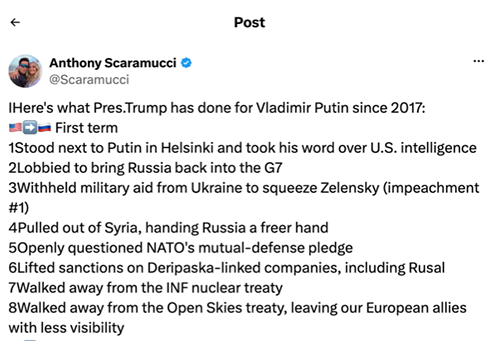
By contrast, Trump's first term now seems tame. In part because of the "deep state" mechanisms in place across much of the US government, many efforts to help Russian interests in the first term were investigated, halted, or delayed. Small wonder, then, that the new target of Russian information operations became the staff of the US government that prevented an overrun of presidential powers in favor of Russia. Given the origin of that propaganda, every time the words "deep state" are mentioned, Russian involvement can be suspected. Still, by any previous standards, the president's efforts to lend "aid and comfort" to Russian economic and military interests were surprisingly loud. In a post on X last week, Anthony Scaramucci, the former Trump first-term White House communications director, outlined the ways in which the president succeeded in lending aid to Russia during that term.
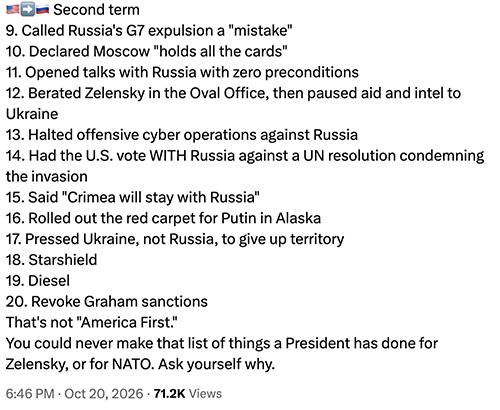
He went on to describe the second term to date, noting that Trump has now:
Enter Elon Musk.
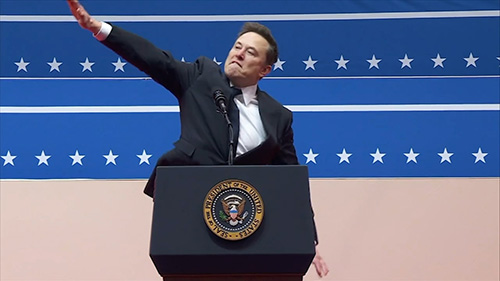
Photo: ABC News The tycoon has traditionally been nothing if not enigmatic. Ornery, cruel, and strange, the past few years have been very kind to Musk financially, and very unkind in many other ways. From being ignored by the Biden administration's EV working group to the increasing hate he has drawn for various late-night descents into neo-Nazism and racist rants, it is perhaps unsurprising that by April of last year he had fallen in the polls to a 33% approval rating. (Trump has now joined him, while Elon's popularity has only slightly recovered, to 37%.) But before Elon's now-infamous Nazi salutes on national television, something else happened. At some point in 2022, he began to have personal private calls with Vladimir Putin. Why this would be necessary is unclear. It is certainly unusual for a businessperson to have such an intimate and direct connection with a former FSB director and president of a foreign adversary nation, particularly while his companies are so heavily contracted by the US government and military. Even more so given that Musk's Starshield (the proper name for the version of Starlink developed for military use) is currently critical to Ukrainian frontline operations and the ongoing drone war in the skies over Moscow. While the Ukraine war raged in the remaining years of the Biden presidency, the Tesla and SpaceX CEO apparently discussed various subjects of interest with the Russian president. As described by the Wall Street Journal when it reported on the debacle: The discussions, confirmed by several current and former U.S., European and Russian officials, touch on personal topics, business and geopolitical tensions. At one point, Putin asked the billionaire to avoid activating his Starlink satellite internet service over Taiwan as a favor to Chinese leader Xi Jinping, said two people briefed on the request. Musk has emerged this year as a crucial supporter of Donald Trump's election campaign, and could find a role in a Trump administration should he win. While the U.S. and its allies have isolated Putin in recent years, Musk's dialogue could signal re-engagement with the Russian leader, and reinforce Trump's expressed desire to cut a deal over major fault lines such as the war in Ukraine. At the same time, the contacts also raise potential national-security concerns among some in the current administration, given Putin's role as one of America's chief adversaries. In October of that year, Musk finished his takeover of Twitter, which he promptly stripped of its safety employees, renamed X, and reopened for Russian bot activity and Donald Trump. The $44 billion acquisition put him in charge of one of the most powerful and most commonly used public sources of online information. After announcing that he would support Donald Trump's 2024 campaign and donating some $290 million to the campaign, Musk seemingly changed the algorithms of the platform to artificially boost Trump content, anti-Kamala Harris content, and Russian propaganda. In a bizarre twist revealed in the new documentary about Musk, he bragged to then-girlfriend (and mother of one of his sons) Ashley St. Clair about tipping the 2024 election toward Trump. As reported by NPR: St. Clair described text messages Musk sent her before the November 2024 presidential election in which he said he was "feeling more optimistic" about Donald Trump winning because "tomorrow we unleash the anomaly in the matrix." When St. Clair asked for clarity, Musk said he planned on tapping "'Lasers' from space," adding that "I have over 10 thousand lasers in space right now." In the film, [filmmaker Alex] Gibney asked St. Clair if she believed Musk's texts referred to satellites owned by his rocket company, SpaceX. She responded, "I don't know where else he has lasers." NPR has obtained and authenticated the texts between Musk and St. Clair, which were sent on Oct. 6, 2024. Regardless of the unnerving claims above, what happened next was an extreme case of alignment between Musk and Russian interests. Post-election, Trump placed Elon at the head of the new (jokingly named) DOGE, or Department of Government Efficiency. This department - staffed by Musk, with no government role, and a series of very young, hand-picked coders with juvenile nicknames - did two things. First, they gutted massive swaths of the US government, illegally firing thousands of federal employees. Then, among the many laws broken during the tenure, they accessed a large amount of data from the Office of Personnel Management and National Labor Review Board using "tenant accounts" with unrestricted permissions. During this process, repeated attempts were made to access this information from Russian IP addresses. This ended with the extraction of 10GB of protected data from servers (it is unknown if the files were compressed) and the sudden attempt to login from Russia to a DOGE-created account using the correct credentials. "Krebs on Security" reported that Daniel Berulis, a security architect at the National Labor Relations Board, ... said he and his colleagues grew even more alarmed when they noticed nearly two dozen login attempts from a Russian Internet address (83.149.30,186) that presented valid login credentials for a DOGE employee account - one that had been created just minutes earlier. Berulis said those attempts were all blocked thanks to rules in place that prohibit logins from non-U.S. locations. "Whoever was attempting to log in was using one of the newly created accounts that were used in the other DOGE related activities and it appeared they had the correct username and password due to the authentication flow only stopping them due to our no-out-of-country logins policy activating," Berulis wrote. "There were more than 20 such attempts, and what is particularly concerning is that many of these login attempts occurred within 15 minutes of the accounts being created by DOGE engineers." While DOGE was not reported to have saved the US government any money, as originally promised (and may, in fact, have cost it quite a bit), it did achieve four major goals that seem to have been shared by Musk and Russian intelligence:
Exfiltrate large quantities of US government-sensitive data. Drastically weaken the security mechanisms of the US government that prevent further data leaks by creating a system and precedent for sudden, against-policy access for unknown individuals who are not clearly government employees to have unrestricted access accounts. Lose, deliver, or allow those unrestricted-access credentials, through one form or another, to fall into the hands of Russian operatives. Musk has also spent a questionable amount of energy meddling in the politics of US allies - again in the direct pursuit of what would be a top Kremlin foreign-policy objective. What appeared to be a flagrantly inappropriate level of support for Germany's right-wing Alternative for Germany (AfD) party on Musk's and Trump's social-media accounts has now been identified as a deeper level of cooperation. A hacked trove of AfD leadership emails this October showed a decade of coordination between the party, both Trump administrations, and Steve Bannon particularly. This is problematic, given the party's known ties to and influence from Russian intelligence. It is also the case that Musk is directly tied to Russian influence operations through the Musk Foundation - which involves other family members but is managed by Musk himself. This summer, the Guardian investigated repeated trips to Moscow by Elon's father, Errol. The elder Musk has apparently been taking trips with European far-right leaders to introduce them to Putin. These trips, Errol himself pointed out, are bankrolled by foundation money. At the same time, fringe congresswoman Tulsi Gabbard was appointed to the position of director of National Intelligence. An odd pick for the job, Gabbard is notable for regular and public expression of support for Russian war crimes in Syria, including having made a personal visit with Bashar Al-Assad, and the invasion of Ukraine. This led to consternation across the aisle and in intelligence circles about her selection. Her presence in the unprecedented FBI seizure of ballots in a raid on an elections office in Fulton County, Georgia, in January 2026 drew increased scrutiny of her activities. She resigned in June 2026. Finally, the beginning of the Iran war in the spring of 2026 marks a significant departure from the caution traditionally exercised around direct military confrontation. While there are significant US interests in the Gulf, and significant US interests related to avoiding a nuclear Iran, neither of those seem to have been particularly relevant at the start of the conflict. The opening of the full-scale war led to the reduction of US bases by attrition, while the administration had previously claimed that strikes on nuclear sites had already achieved a dramatic reduction of Iran's ability to ever build a nuclear weapon. The reason for urgency in the Gulf - and the future outcome itself - remains unclear, but notable outcomes to date include:
The expenditure of large numbers of missile interceptors, reducing stocks to minimal levels, thus removing the inventory available to Ukraine and Europe The doubling of oil prices worldwide, endangering the energy security of US allies across Europe and Asia and leading to further inflation and cost-of-living crises that are increasingly destabilizing allied nations Finally, Trump administration economic policy has so far followed a strange trajectory as well. It is unusual to see an administration so carelessly and systematically drive up the cost of living directly before a midterm election. While Trump's moves last week to buy diesel from Russia seem at face value like a response to this cost-of-living crisis, the quantities are so low that the only real outcome will be a cash delivery to the Russian state that may or may not result in a diesel delivery of one-half of one day of US supply needs. Meanwhile, a series of surprising tariffs on allies have led us to a point where the key economic outcomes during the second administration are as follows:
Alienation of most US allies, diplomatically and economically, as well as a weakening of allied economies A rapid rise in the cost of healthcare and other social services due to DOGE and other cuts The elimination of food safety regulations, leading to a dramatic worsening of the quality of the US food supply The bankrupting of farms through tariffs and removal of farm labor, leading to a dramatic worsening of the quantity of the US food supply Removal of regulations providing for the continuity and quality of the nation's supply of drinking water A reduction of teams across the Centers for Disease Control (CDC) and other health bodies tasked with preventing outbreaks of infectious disease, with the immediate result being an increase in the burden of disease All of this could have been written by a strategist in the halls of the Kremlin. All of it destabilizes the basic tenets of the security of the nation, both politically and on the ground.
If Bezmenov's description of the Soviet strategy to destroy the United States is to be believed, the pattern seems to be repeating. The trajectory and actions detailed above show ongoing efforts by the Russian state to generate the demoralization and destabilization of the United States and its allies. More important, they show the support of the Russian state for the Trump administration throughout two US election cycles. First, the manner in which funds, aid, and assistance were provided to ensure that Trump got into office was defined by the Kremlin. Second, Russian contact appears to have immediately predated assistance of Trump in the election cycle. This seems to be the case with multiple key individuals without whom he would not have been able to enter the White House. It is extremely suspicious to see so many instances of aid to an American politician by those who have just been touched by Russian operatives or associates. Bezmenov's warning included a description eerily similar to what is occurring now. The use of psychological and information warfare and "active measures" to demoralize and destabilize the United States is remarkably close to what he described so long ago. The next stage, of course - Stage 3 - is Crisis. If Russian interests believe that the US environment is sufficiently prepared, a crisis stage could be imminent. The destabilization criteria detailed by Bezmenov (the economy, institutions, and foreign-policy capability) have been clearly fulfilled. With the US midterm elections bearing down, the administration's popularity at an all-time low, and Ukraine taking territory in Donetsk and killing Russian troops even faster than before, it is possible that Putin may see this moment as his last good opening to disrupt US operations. In fact, at a Council on Foreign Relations session at the end of September, Polish Deputy Prime Minister Radosław Sikorski effectively said as much. Explaining that Putin needs a pretext for further military mobilization, and that the types of crises that could be manufactured by Russian intelligence are myriad (including false-flag attacks on Russia itself), Sikorski noted (as transcribed by SNS): We are getting intelligence from multiple sources - we don't identify sources, but it's multiple - that Russia is cooking up something big this year. For obvious reasons, we have yet to reach Stage 4 (Normalization). What is clear is that the question of whether we will be forced, as a nation, to deal with such consequences is up to us.
A decision by Elon Musk led to restrictions on Ukraine's use of SpaceX's satellite communications network, people familiar with the matter told CBS News. The satellite service, which is used for drone operations, hitting certain targets and protecting sites in Ukraine, was slowed significantly last week. Musk held multiple conversations with administration officials leading up to the order, the sources said. He wanted clarity on the president's thinking on the matter. Musk has expressed distaste with his company being seen as profiting from the continued war between Russia and Ukraine. - CBS News (10/21/26) Since at least 2024, a network of individuals working for the intelligence services of the Russian Federation (the "RIS Network") has conspired to conduct and conducted attacks and murders around the world, including within the United States. The RIS Network is one arm of the Russian Federation's apparatus to carry out external attacks, including murder, and has focused on Russian dissidents and defectors and, most recently, on nations perceived as allies of Ukraine. Most recently, members of the RIS Network have attempted to recruit multiple individuals within the United States to carry out pre-operational surveillance and murder within this country. - US Department of Justice Press Release, "Members of Russian Intelligence Services Network Charged
With Russian influence and terrorism campaigns at an all-time high across the United States and Europe, one might expect the US government to be following Bezmenov's recommendations for cutting off all trade, credit, technology, and transactions with the Russian Federation. Just last month, the FBI interdicted an FSB assassination attempt on US soil, while Europe has been inundated with arson, bomb plots, and most recently the drone attack on the Leipzig / Halle Airport perpetrated by Russian intelligence agencies. Under past US administrations, such brazen escalation would have led to serious consequences. Instead, the Trump administration has been focused on providing Russia with aid and comfort. Information broke in mid-September that Donald Trump Jr.'s wedding was paid for by a Russian oligarch closely linked to Putin; the oligarch was also in attendance at the wedding. Such a level of open financial compromise is downright shocking. US Special Envoy Steve Witkoff and Trump son-in-law Jared Kushner are now negotiating deals over assets of Lukoil - the Russian conglomerate known for funding espionage - for interests in the Middle East who gave money in various forms to Trump personally. In a very short period of time, Donald Trump has:
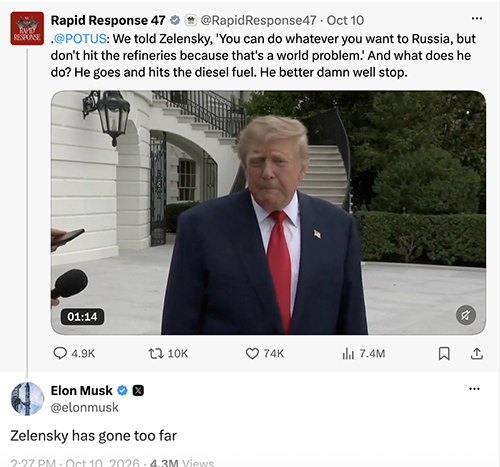
All of this came in a flurry starting on October 9. Notable here is the timing. On October 8, Ukrainian drones struck a series of data centers managed by Yandex - Russia's answer to American tech companies like Amazon and Google. The effects were immediate: loss of banking and internet services in major Russian cities and, Zelensky claimed, a sudden absence of Russian trolls online around the world. Whether or not the Russian trolls were affected seems to be up for debate, with many pointing out that web-crawler HTTP traffic dropped, but there was no clear reduction in actual bot accounts on social media. But the response from the largest beneficiaries of such fake accounts, and from Russian tech infrastructure in general, is telling. Something happened on October 8 that caused a measurable change in Trump administration policy toward Russia. For his part, Musk immediately jumped on X to declare that "Zelensky has gone too far." But Ukraine has been hitting refineries all year.
Shortly thereafter came the sudden degradation of Starshield products in Ukraine. While it is unclear whether Musk or the Pentagon or the White House - or all three - were complicit, all three would need to be involved to realize such a move. A seeming lack of intelligence sharing from the Pentagon to the Ukrainian military came next, proscribing Ukraine's ability to detect the incoming large-scale Russian missile strikes that would shortly follow. Trump then demanded a surprise "energy ceasefire" that neither Russian nor Ukrainian authorities stated they had heard wind of. When asked, Trump's response was that a ceasefire existed because he declared that it did. Ukraine held off on hitting Russian oil assets for two days in an apparent attempt to engage in good faith. The first night, however, Russia resumed striking Ukrainian energy targets. The timing of American moves to help Russian interests and allow Russia to better strike Ukraine is a red flag of unprecedented proportions. The potential for influence of the Russian state with all of the individuals involved is at an all-time high. With the US midterm elections fast approaching, it could be surmised that Russian intelligence is calling in its favors. If so, the secondary implication is that Putin is not sure the results will be in his favor. This would be good, if Bezmenov's Stage 3 could be ignored. It is far from clear that it can.
You do not need to believe any unproven theory to be alarmed by the documented record. A Soviet bloc intelligence service watched Trump's family for more than a decade. Russian money flowed into his properties for years. He secretly pursued a Kremlin-dependent deal while Russia worked to elect him. His campaign chairman shared data with a Russian intelligence officer. As president, he sided with Putin over his own intelligence agencies, handed classified information to Russian officials the day after firing the FBI director investigating him, and withheld aid from Ukraine to pressure its president. Now, in his second term, the pattern has become policy. Sanctions are waived. Air defenses are delayed. Ukraine's president is attacked while Russia's is welcomed on a red carpet. - The Parnas Perspective, Aaron Parnas, "Exposing Trump's Deep Ties to Russia" (10/23/26)
On Friday, October 23, Aaron Parnas released a list of longtime ties between the Trump organization and Russian interests. From being tracked by Czech intelligence in the 1970s to Moscow trips in the '80s to various sources of funding, money laundering, and influence campaigns, Parnas effectively fleshes out the work Catherine Belmont did in Putin's People, but in greater detail and with added stories. The piece is worth reading in its entirety - but the gist of it is the same as we have broadly outlined in these pages. The ties are myriad, the funds delivered immense, and the assistance with election campaigns clear. Gone are the days where cries of "hoax" could even sound meaningful. What we face now is a completely different dynamic. With the administration actively working to hamper Ukrainian frontline operations, contemplating regular personal visits to Moscow, and taking money directly from Kremlin oligarchs, the level of cooperation between the administration and Putin, Russian intelligence, and Russian oligarchs has reached a crescendo. Russia is a top US adversary. It is the premier NATO adversary. It is waging gray-zone warfare across Europe, and, as the Department of Justice itself announced in the press release cited earlier, on US soil. It is a key member of the CRINK alliance that seeks to destabilize the US and its allies. The potential plan for a "Yalta 2.0" meeting in Beijing with America's biggest adversaries to discuss the future of Ukraine would, at this juncture, be extremely ill-advised. But a full-fledged, 40-year campaign to take billions in KGB (and, later, FSB) and Russian oligarch money, work with a foreign adversary to demoralize the population, interfere with US elections, and destabilize and kneecap American soft and hard power abroad? That is giving aid and comfort to the enemy.
Your comments are always welcome.
Sincerely, Evan Anderson
Copyright 2026 Strategic News Service. Redistribution prohibited without written permission. DISCLAIMER: NOT INVESTMENT ADVICE Information and material presented in the SNS Global Report should not be construed as legal, tax, investment, financial, or other advice. Nothing contained in this publication constitutes a solicitation, recommendation, endorsement, or offer by Strategic News Service or any third-party service provider to buy or sell any securities or other financial instruments. This publication is not intended to be a solicitation, offering, or recommendation of any security, commodity, derivative, investment management service, or advisory service and is not commodity trading advice. Strategic News Service does not represent that the securities, products, or services discussed in this publication are suitable or appropriate for any or all investors.
We encourage you to forward your favorite issues of SNS to a friend(s) or colleague(s) 1 time per recipient, provided that you cc info@strategicnewsservice.com and that sharing does not result in the publication of the SNS Global Report or its contents in any form except as provided in the SNS Terms of Service (linked below). To arrange for a speech or consultation by Mark Anderson on subjects in technology and economics, or to schedule a strategic review of your company, email mark@stratnews.com. For inquiries about Partnership or Sponsorship Opportunities and/or SNS Events, please contact Berit Anderson, SNS COO, at berit@stratnews.com.
Sunday, October 18, 2026 HANDICAPPING THE WEALTH TAX QUAGMIRE By Berit Anderson Ahead of the midterm elections, conversations about US wealth taxes - in all their varied forms - have become politically incendiary, rife with strong opinions but light on evidence. This week's Global Report looks to change that, combining analysis of domestic migration within and between states with historic responses of capital and investment to such policies across the US; and explaining how the states championing these policies - and their economies - are likely to be affected.
Sunday, October 11, 2026 THEY BUILT THE GUN, THEY PULLED THE TRIGGER By Mark Anderson While the Anthropic crew is marketing their large language models as humanity-ending murderers that are also religious beings who might need to confess as in the Catholic tradition, and OpenAI ships product (or threatens to) with less chain of thought explainability, even as it fires members of its safety team ... it is not just possible, but also likely, that this whole hype circus can be reduced to a single tech storyline, without any of what the Irish, in a recent peer-reviewed paper, labeled "bulls**t." In this discussion, we will provide that simple thread.
Sunday, October 4, 2026 THE TRILLION-DOLLAR PROMISE II: Truth and Consequences By Evan Anderson The LLM boom always sounded irrational to anyone paying attention to the buildout statistics touted by its top spokespeople. The ubiquitous deployment of flawed LLMs was "projected" to cost trillions, and to achieve exactly what result was never quite clear. This week, we take a look at what we were told would happen, what actually happened, and what is likely to come.
Sunday, September 27, 2026 SNS: ASIA LETTER: Q4 2026: TDK INSIDE By Scott Foster
Sunday, September 20, 2026 THE EQ ADVANTAGE IN AN AGE OF AI PSYCHOPATHY By Berit Anderson Every day, headlines drill into the existential threat of AI, but the real threat is how often models are wrong and how much top FAANG leaders driving these models build them in their own image - as manipulative, overconfident liars.
* Mark will be joining this month's virtual SNS Spark salon on Thursday, October 29; join him for another invigorating online conversation. (SNS members: Click on the ad above for your free registration.)
Strategic News Service (SNS) is a membership-based news organization providing the most accurate source of information about the future of technology as it drives the global economy. It is the publisher of the weekly SNS Global Report, which brings members predictive, deep-dive analysis at the intersection of tech, economics, and geopolitics. SNS hosts monthly virtual Spark salons, offering members access to its global network of leaders in business and industry and allowing them to capitalize on the insight and experience of the broader network. Annually, SNS releases CEO Mark Anderson's Top 10 Predictions for the coming year, which have a 95.3% publicly graded accuracy rating. Founded in 1995, the Global Report is read by industry leaders worldwide. Bill Gates has called it "the best thing I read."
Copyright 2026 Strategic News Service LLC "Strategic News Service," "SNS," "Future in Review," "FiRe," "INVNT/IP," and "SNS Project Inkwell" are all registered service marks of Strategic News Service LLC. ISSN 1093-8494 | |